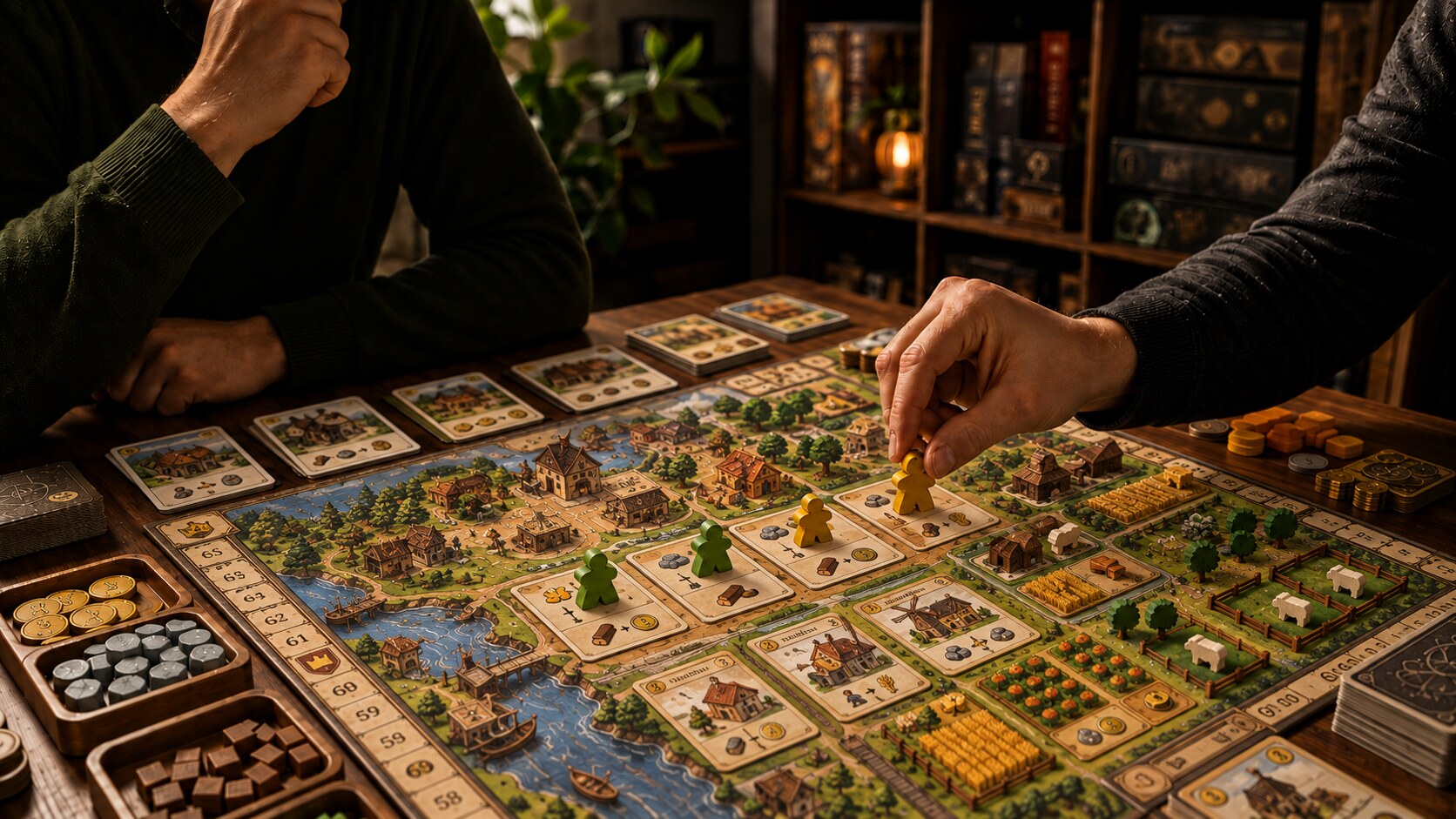
You may have heard a more experienced board gamer describe Brass: Birmingham, Agricola, or Terraforming Mars as a Eurogame or confidently announce that Euros are their favourite type of board game. Everyone else at the table seems to understand exactly what that means, while you are left wondering whether it refers to games made in Europe, games with complicated rules, games including economy or simply games for serious players.
The term is common, but its meaning is not as obvious as it first appears. Eurogames can be light and accessible or long and demanding. Some use dice, some include strong player interaction, and some place much more emphasis on theme than the traditional definition might suggest.
So what actually makes a game a Eurogame and why do so many players find the genre so satisfying?
From German-Style Games to a Global Genre
The term grew out of a board game tradition that became particularly influential in Germany, where designers increasingly focused on accessible rules, limited player elimination, meaningful choices, and ways of keeping everyone involved until the end. During the 1990s, games from this tradition began reaching a much wider international audience. Catan, released in 1995, became one of the most visible examples and helped introduce many players outside Germany to a style of board game that felt different from both traditional family games and conflict-heavy strategy games.
We explore Catan’s role in the rise of modern board gaming in more detail in Why Catan Changed Modern Board Games.
Today, the term describes a recognisable type of gameplay experience rather than a country of origin. It covers relatively accessible titles such as Catan and Ticket to Ride, as well as more demanding games such as Brass: Birmingham, Barrage and Terraforming Mars.
These games can differ considerably in complexity, theme, interaction, and mechanisms. What connects them is not a strict checklist, but a group of design characteristics that often appear together.
Classic and Modern Eurogames
The genre has also changed considerably since the era of classic German-style games. Many earlier Eurogames relied on relatively streamlined rules, shared boards, and a small number of mechanisms that created depth through interaction and difficult choices.
Modern Eurogames can be much heavier, combining engine building, asymmetric player powers, personal boards, multiple scoring tracks, card systems, and several interconnected mechanisms.
This evolution is one reason the term can be difficult to define today. Catan, El Grande, Agricola, and a modern heavy Euro by Vital Lacerda may feel very different at the table, yet they belong to the same broad design tradition.
It is therefore more useful to think of Eurogame as a spectrum of recurring design characteristics rather than a category with fixed requirements.
The Defining Features of Eurogames
It is useful to separate Eurogame, strategy game, and economic game. They are not competing labels. Strategy is a broader category, while economic games focus on systems such as production, trade, markets, or investment. A title such as Brass: Birmingham can comfortably be all three.
Eurogames themselves are better recognised through recurring design qualities.
Meaningful Trade-offs and Multiple Paths
Eurogames often ask players to choose between several worthwhile directions rather than search for one obviously correct move. Committing to one plan may delay another, and an opportunity that is valuable now may conflict with something you want to achieve later.
Strong Eurogames make those trade-offs interesting because different approaches can remain viable. The challenge is not simply finding the best action in isolation, but deciding which choice best supports the plan you are building and when that plan needs to change.
Interconnected Systems
Eurogames often create depth by making one part of the game affect several others. Improving production might expand your future options, a new ability may change the value of resources you previously ignored, or progress in one system may open opportunities elsewhere.
This means players are rarely evaluating a rule or mechanism in isolation. A decision made in one part of the game can change what becomes possible or valuable in another.
The depth comes from understanding the relationships between systems, not simply from having more systems.
Everyone Stays in the Game
Player elimination is uncommon. Progress is more often measured through victory points, objectives, developed systems, or some combination of them.
Even when a player falls behind, they usually continue making decisions and developing what they have built. The competition may be intense, but the game generally tries to keep everyone involved until the end. As games are quite long, you can often see catch-up mechanisms included.
Common Misconceptions About Eurogames
Eurogames are often described through a few convenient stereotypes. Modern designs make those definitions increasingly unreliable.
Myth: “Theme does not matter.”
Eurogames often put mechanisms at the centre of the challenge, but theme can still give those systems meaning. Feeding your family in Agricola, for example, turns an efficiency problem into something immediately understandable and creates pressure that fits the setting.
Myth: “Eurogames cannot rely on luck.”
Dice, card draws, and variable setups can all appear in Eurogames. What matters more is whether players retain meaningful ways to respond to uncertainty rather than having the outcome decided for them.
One useful distinction is between input randomness and output randomness. With input randomness, uncertainty appears first and the player then decides how to respond: the available cards change, resources appear, or the setup creates a new situation. With output randomness, the player chooses an action first and a random result then determines whether it succeeds.
Neither approach belongs exclusively to one genre, but input randomness often fits the Eurogame emphasis on giving players meaningful control over how they respond to uncertainty.
Myth: “Eurogames have little player interaction.”
Interaction may be less destructive than in many conflict-heavy games, but claiming action spaces, taking scarce resources, competing for objectives, changing shared markets, or blocking routes can create considerable tension.
Common Mechanics in Eurogames
Eurogames use many different mechanisms, but some appear particularly often because they support planning, trade-offs, and interconnected decisions.
Common examples include:
- Worker placement - Players claim action spaces whose availability changes as other players make their choices.
- Engine building - Early investments make later actions increasingly productive.
- Resource management - Players decide how limited resources should be spent, saved, traded, upgraded, or transformed.
- Drafting - Players choose from options whose availability may change as others act.
- Action points - Players are restricted to take a particular number of available actions during their turn. It used to be a way more popular approach before worker placement took its place.
- Tile and network building - Placing routes, connections, or tiles changes the shared space and creates new possibilities or restrictions.
- Auctions and bidding - Players compete by deciding how much an opportunity is really worth.
Set collection, contract fulfilment, area control, variable player powers, and many other mechanisms also appear regularly.
If you want to explore these systems beyond the Eurogame genre, our guide Board Game Mechanics: Common Mechanisms Explained introduces the most common mechanics and links to deeper articles on each one.
Why Players Find Eurogames Rewarding
For many players, the appeal comes from ownership over the result. A strong performance feels like the cumulative effect of decisions made across the entire game rather than one decisive moment.
Plans can pay off several turns later. A modest early investment may eventually become a productive engine, an efficient network, or an unexpected source of points. The reward comes from recognising the chain of decisions that made it possible.
Understanding grows with repeated plays. The first game may be mostly about learning the rules. Later sessions reveal inefficient choices, combinations you missed, timing you misunderstood, and strategies you had not considered.
Different approaches create reasons to return. A finished game can leave you wondering whether another route, strategy, or opening decision might have produced a completely different result.
That feeling is an important part of Eurogame appeal. You are not simply learning how the rules work, you are gradually learning what the game hides.
A good Eurogame often ends with one immediate thought: “Next time, I want to try something different.”
Competition also plays a role, but it does not always require destroying another player’s progress. Much of the tension comes from recognising opportunities before someone else does, reaching an action first, or taking a resource another player was hoping to use.
The final position therefore feels personal. Whether you built a farm, developed an economic network, or created a powerful engine, the result reflects a plan that you shaped yourself.
What Designers Should Watch for in a Eurogame
The same qualities that give Eurogames their depth can also make them difficult to design well. More systems, options, and scoring paths do not automatically create better decisions.
A few things are especially worth watching:
- Complexity should create decisions, not administration. If players spend more time maintaining systems than choosing between meaningful options, additional mechanisms may be adding work rather than depth.
- Multiple paths should remain genuinely viable. Different strategies do not need to be equally strong in every situation, but one obvious route should not consistently make the others irrelevant.
- Interaction should matter without destroying agency. Blocking, competition for spaces, shared markets, and scarce resources can create tension, but players should still have meaningful ways to adapt.
- Randomness should create situations to solve. Uncertainty can improve replayability and force adaptation, but players need enough control to respond rather than simply accept what happened.
- Systems should reinforce one another. If a subsystem could disappear without changing the important decisions players make, it may not be earning its complexity.
The goal is not to give players more things to do. It is to give them more meaningful reasons to choose one thing over another.
Conclusion
Eurogames have changed considerably since the German-style games that gave the genre its name. Today, they can be light or heavy, thematic or abstract, relatively peaceful or highly competitive.
What connects them is not one mechanism, theme, or complexity level. It is an emphasis on meaningful decisions, interconnected systems, limited opportunities, and enough player control for the result to feel earned.
That combination gives Eurogames their characteristic sense of deliberate, cumulative progress, even when the individual mechanisms differ dramatically from one game to another.
Want to Go Deeper?
Understanding what defines a Eurogame is one thing. Designing a game with meaningful trade-offs, interconnected systems, viable strategies, and enough player control is much harder.
Board Game Design Fundamentals: A Step-By-Step Guide takes you through the wider design process: from defining the experience and building your first prototype to playtesting, iteration, and preparing the game for further development.