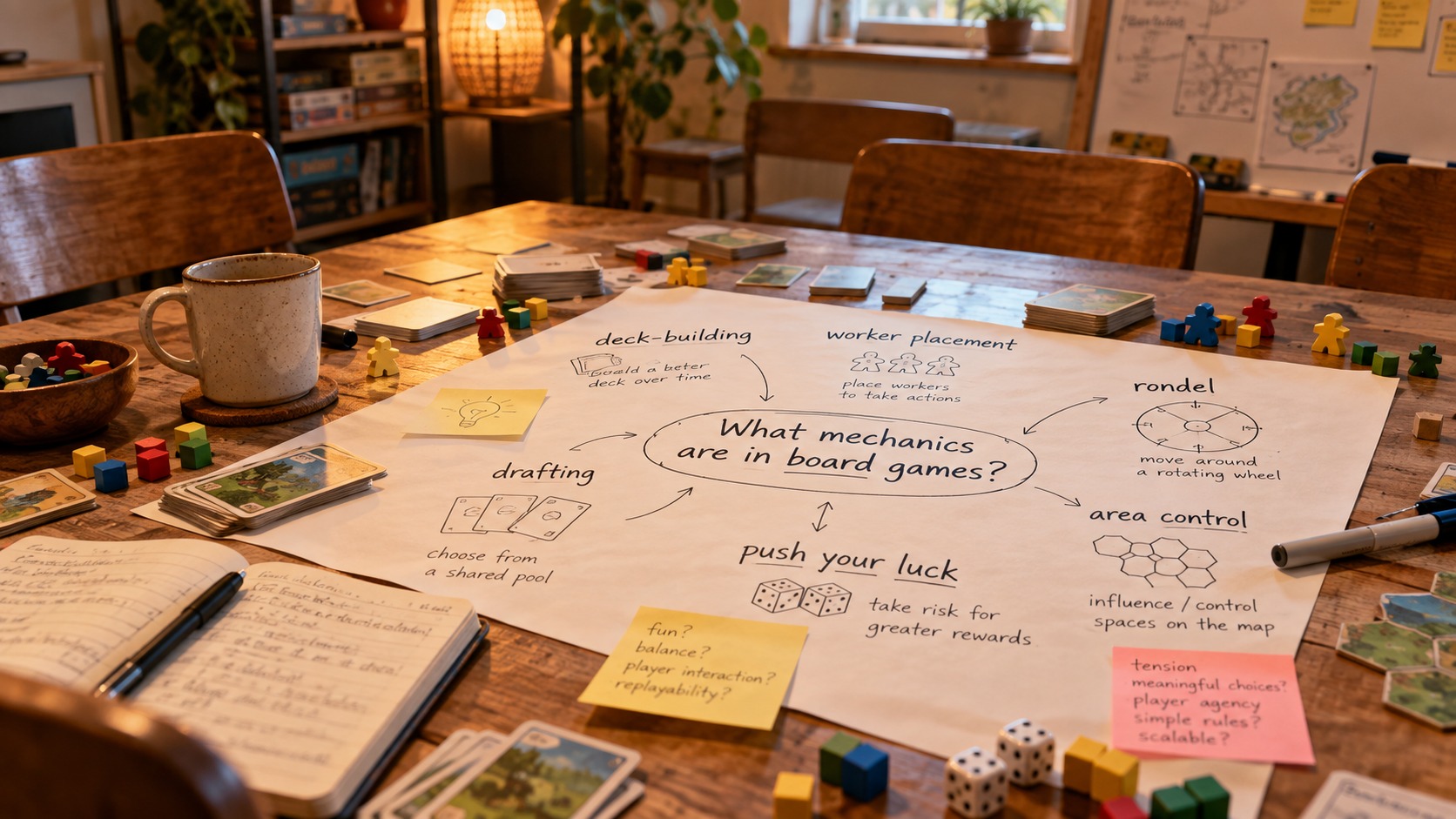
Have you ever searched for a list of board game mechanics? We have, too. So hopefully what we created based on our years of experience will help you today.
Board Games are not as simple as pages of rules. What they actually offer is an environment created out of mechanics, interactions between players, theme, restrictions, and components. Today we will focus on mechanics: the actions, systems, and rules that determine what players can do and how their decisions affect the game.
Drawing cards, placing workers, bidding, building routes, collecting sets, or pushing your luck are all examples of mechanics. Most games combine several of them, and the interesting part is often not the presence of one mechanic, but how different mechanisms work together to create decisions and shape the player experience.
This guide introduces some of the most common board game mechanics. Each explanation is intentionally brief, with links to deeper articles where we explore how individual mechanisms work, why they are engaging, and what designers should watch for when using them.
Mechanic, genre, and game type are not always separated cleanly in everyday board game language. Deck-building, for example, is technically a mechanism, but games built around it are commonly described as deck-building games. This guide focuses on the systems players interact with rather than trying to impose a rigid classification. We followed a design approach, so each mechanic is put into the category referring to a game element you might be working on.
Building and Developing Your System
Some mechanics focus on how a player’s capabilities grow over time. The choices made early in the game influence what becomes possible later, creating a sense of progression as players develop stronger, more efficient, or more specialised systems.
Deck-Building
Players improve a personal deck during the game by acquiring new cards that change future hands, create combinations, and open up strategic options. Because those cards return later, every purchase can affect not only what a player can do, but how consistently their deck performs.
Read more: What Are Deck-Building Games? How Every Card Changes Your Strategy
Engine-Building
Players create systems that make future actions increasingly productive, efficient, or powerful. An early investment may generate more resources later, reduce future costs, or unlock combinations that become stronger as the game progresses.
Resource Management
Players acquire limited resources and decide when to spend, save, trade, convert, or invest them. The tension usually comes from having more useful things to do than resources available to do them, so- called heavy trade-offs.
Action Mechanics
Some mechanics focus on how players choose what to do and how access to those actions is limited, shared, or contested. Different systems create tension in different ways: by blocking spaces, restricting timing, passing options between players, or making them compete for priority. In other words, action mechanics define what you can do on your upcoming turn or round.
Worker Placement
Players assign workers to action spaces to perform specific actions. Because spaces are often limited, choosing where to place a worker can also block or delay another player’s plan.
Drafting
Players choose cards, tiles, dice, or other elements from a shared selection before passing or revealing the remaining options. Every choice affects not only what you gain, but what may still be available to everyone else.
Auctions and Bidding
Players compete for resources, positions, contracts, turn order, or other advantages by deciding how much they are willing to give up to secure them. The strategic challenge lies in judging what an opportunity is really worth.
Rondel
Players move a marker around a circular sequence of actions. Which actions are available depends on the marker’s current position and how far it can move, making the order in which actions are taken part of the strategy.
Role Selection
Players choose roles or phases that determine which actions become available during the round. In some games, selecting a role also allows other players to perform a weaker version of the same action.
Action points
Players are restricted to take a particular number of actions from the pool during their turn. Usually those actions interact with various components around the table in completely different ways.
Space and Position Mechanics
Some mechanics focus on where players place pieces, how they expand across the board, and how control of space changes future options. These systems often create tension without requiring direct attacks: reaching a location first can be enough to disrupt another player’s plan.
Area Control
Players compete to control specific areas of the board, often by occupying, defending, or expanding into them. Control may provide points, resources, abilities, or strategic access. One thing that distinguishes it from worker placement is that bonuses you get from control are usually passively multiplied over time, while worker placement gives a one-time bonus.
Area Majority
Players compete to have more influence than their opponents within an area. The space itself may remain shared, but the player with the greatest presence receives the main reward. Sometimes considered an Area Control submechanic.
Tile Placement
Players add tiles to build or modify the playing area. The value of a tile often depends as much on where it is placed as on what the tile itself contains.
Route and Network Building
Players create connections between locations by building roads, tracks, paths, or other links. The challenge often comes from choosing efficient routes while competing for limited destinations or blocking future expansion.
Movement
Players move pieces across a board or map, with position determining which actions, resources, opponents, or objectives become available. Movement can be a simple way to reach a destination or a central strategic puzzle in its own right.
Risk and Uncertainty Mechanics
Some mechanics focus on making decisions without knowing exactly what will happen next. Randomness, hidden outcomes, and increasing risk can create tension when players still have meaningful ways to respond. The important design question is not simply how much randomness exists, but how much control players retain over what happens next.
Dice Rolling
Players roll dice to determine resources, movement, combat results, available actions, or other outcomes.
Push Your Luck
Players choose whether to keep what they have already gained or risk it for the chance of a better result. The tension comes from deciding when enough is enough.
Random Card or Tile Draw
Cards or tiles introduce changing information, opportunities, or obstacles that players cannot fully predict. Random draws work best when they create new situations to solve rather than simply deciding the result.
Bag Building and Bag Drawing
Players draw tokens or other components from a bag, often adding, removing, or changing its contents during the game. Like deck-building, the composition of the bag can become something players deliberately shape over time.
Roll-and-Write / Flip-and-Write
Players receive a shared or individual random result, then decide how to use it on their own sheet or board where they write their decision results. The randomness creates the available options, while the strategic challenge comes from how each player interprets and uses the same information. Even though it is an evolution of an already known mechanic, we decided its usage has become so common that it is worth putting here.
Interaction and Information Mechanics
Some mechanics focus on what players know about one another, what they choose to reveal, and how they influence decisions through communication, deception, or incomplete information. Much of the tension comes from reading other players rather than only reading the board.
Trading and Negotiation
Players exchange resources, promises, information, or other advantages directly with one another. The value of an offer depends on what each player needs, what they believe others are planning, and how much they are willing to reveal. A game can either not allow breaking the deal/punish the breaking player or leave vengeance to a victim.
Hidden Information
Some information is known only to individual players. This forces others to make decisions based on incomplete knowledge, deduction, probability, or assumptions about what opponents may hold.
Bluffing
Players deliberately create uncertainty about what they have, know, or intend to do. The mechanism turns information itself into something that can be manipulated.
Hidden Roles
Players have secret identities, allegiances, or objectives that are not known to everyone else. The challenge comes from interpreting behaviour while trying to protect or disguise your own role.
Social Deduction
Players try to identify hidden roles or intentions by analysing conversation, voting, accusations, inconsistencies, and other social signals. The game’s systems provide structure, but much of the actual puzzle is created by the players themselves.
Pattern and Combination Mechanics
Some mechanics focus on how individual elements become more valuable when arranged, grouped, or combined in the right way. The challenge often comes from recognising relationships between pieces and collecting them rather than evaluating each one in isolation.
Set Collection
Players gather groups of matching or related cards, tiles, resources, or other elements. The value usually comes from completing particular combinations rather than from the individual items themselves.
Pattern Building
Players arrange pieces, tiles, cards, or symbols into specific configurations. Position and adjacency often matter, making spatial planning part of the puzzle.
Tableau Building
Players build a personal display of cards or tiles that remain in front of them and continue to provide abilities, resources, scoring opportunities, or interactions with other elements.
Card Combination and Synergy
Players combine effects that become stronger or more useful together than they would be separately. The strategic challenge lies in recognising which elements reinforce one another and building around those relationships.
Trick-Taking
Players contribute cards to a shared trick, usually following restrictions on what may be played. Much of the strategy comes from tracking what has already appeared, controlling when certain cards are used, and anticipating what opponents may still hold.
Timing and Turn Order Mechanics
Some mechanics focus on when players act, in what order, and how much they know before committing to a decision. Changing the timing of actions can create tension even when the actions themselves remain simple.
Simultaneous Action Selection
Players choose actions at the same time, often revealing them together. This reduces downtime and can create uncertainty because decisions must be made without knowing how others' choices will affect the strength of our pick.
Action Programming
Players plan a sequence of actions in advance and then resolve them later. The challenge comes from predicting how the board may change before those actions actually happen.
Turn Order
Players compete for or manipulate their position in the turn sequence. Acting earlier may provide access to scarce opportunities, while acting later can provide more information before making a decision.
Time Track
Instead of following fixed rounds, the player furthest behind on a shared time track acts next. More powerful actions may consume more time, turning how often you act into part of the decision.
A Game Is Usually More Than One Mechanic
Very few board games are built around a single mechanic. A deck-builder may also use drafting, combat, movement, or engine-building. A Eurogame may combine worker placement, resource management, contracts, tracks, and several other systems.
What makes a design interesting is rarely the presence of one mechanic in isolation. It is what happens when several mechanics begin engagingly influencing one another.
For designers, the useful question is therefore not simply:
“Which mechanics should my game have?”
but:
“What decisions and experience do I want for my players? What mechanics connection can achieve it?”
If you are still developing your first game, How to Design a Board Game: What Every Beginner Should Know explains where mechanics fit into the wider design process.
Want to Go Deeper?
Understanding individual mechanics is a useful starting point. The harder part is choosing which ones support the experience you want to create, combining them into a coherent system, and testing whether they actually work together at the table.
Board Game Design Fundamentals: A Step-By-Step Guide takes you through that wider process, from defining the experience and building your first prototype to playtesting, iteration, and preparing the game for further development.