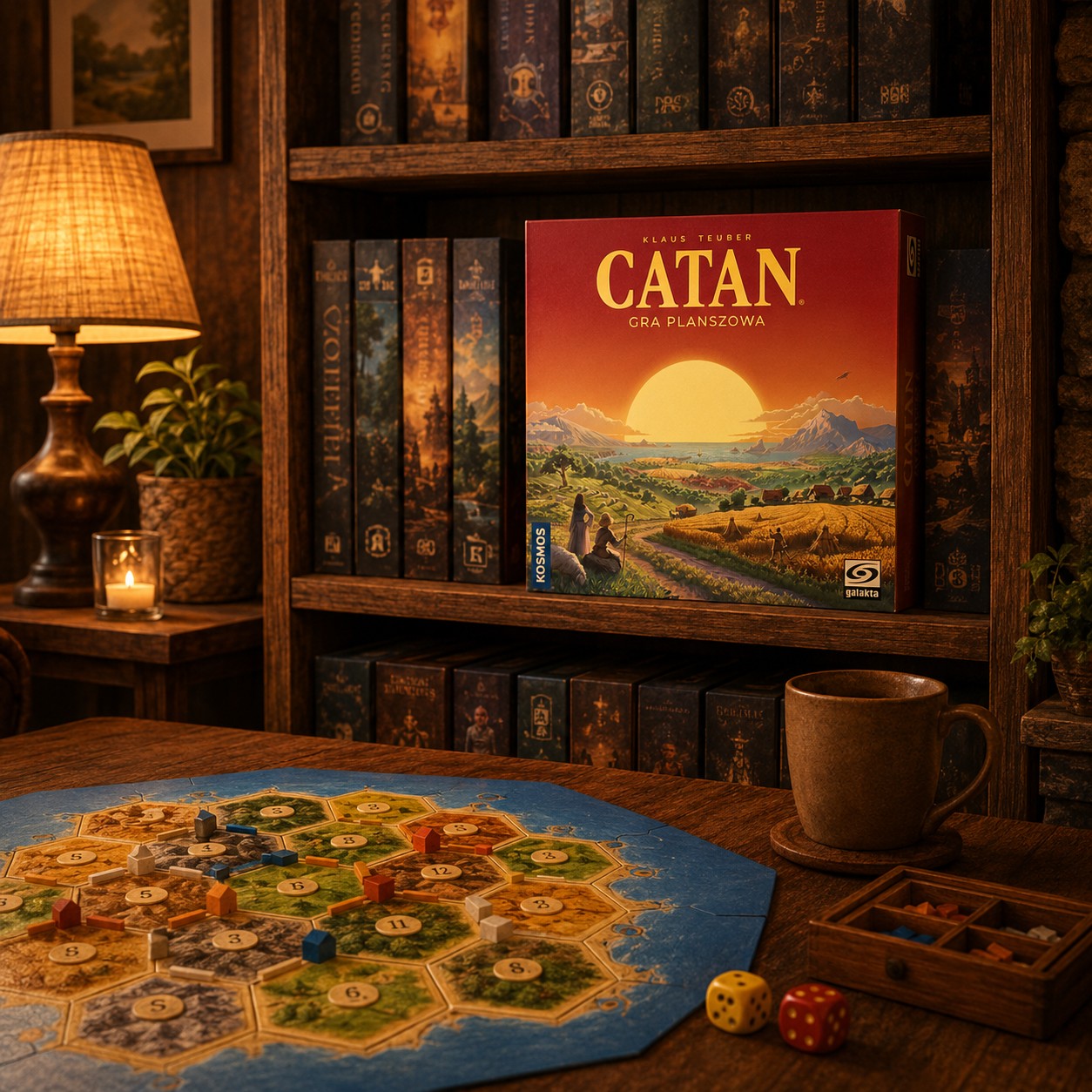
Ask a group of board gamers what they think about Catan, and you are unlikely to receive a neutral answer. For some, it was the game that revealed how different board gaming could feel beyond familiar mass-market titles. For others, it brings memories of unlucky dice rolls, poor starting positions, and long stretches spent watching opponents collect resources.
Yet more than three decades after its original German release in 1995, players are still discussing whether it remains a great design or simply an important one.
What Happens in Catan?
Players develop settlements across a modular island, collecting brick, lumber, wool, grain, and ore when dice rolls activate the terrain beside their buildings. Those resources are used to build roads, establish new settlements, upgrade cities, and acquire development cards.
No player is likely to produce everything they need, which makes trading and positioning central to the game. Players negotiate for missing resources while competing for valuable building sites and routes across the island. The first player to reach ten victory points wins, but how they get there depends on probability, scarcity, negotiation, and spatial competition.
One Roll Changes the Whole Table
A six is rolled. One player receives brick they do not currently need. Another already has the lumber for a road but is missing exactly that brick. A third watches the proposed trade and realises where the road is probably heading.
Nothing spectacular has happened - only one dice roll. But the situation around the table has changed.
A roll in Catan does more than distribute resources. It changes what players can build, what they need from one another, and which plans suddenly become possible.
The number tokens are not equally likely to activate. Sixes and eights appear more often than twos and twelves, which makes some locations more reliable than others. But probability only describes what is likely to happen over time. Individual rolls determine who has leverage right now.
That changing distribution keeps players watching rolls even when it is not their turn. Resources are constantly moving in and out of scarcity, and as scarcity changes, so does their value.
The Table Sets the Price
Catan has fixed exchange rates with the bank and ports, but direct trades are negotiated freely. That means a resource has no fixed value between players: a brick may be useless to one player and exactly what another needs to complete a road.
Values also change as the game develops. Grain and ore may become more desirable as cities appear, while brick and lumber can lose importance once the best expansion spaces are gone.
As many Catan players discover, nobody wants your sheep until, very suddenly, everybody does.
Trades also reveal intentions. Repeatedly asking for a particular resource can tell the table something about what a player intends to build next. Every deal therefore carries a second question: does helping myself help someone else too much?
The rules set the requirements. The players set the market.
You Can Trade for Brick, Not for Space
Resource shortages can often be solved through negotiation. Spatial shortages cannot. Once another settlement claims an important intersection, that opportunity is gone.
Roads therefore compete for future options, not only immediate points. Building towards a productive intersection or valuable port can secure your own expansion or force an opponent to change theirs.
This creates conflict without requiring players to destroy what someone else has already built. You may not remove an opponent’s settlement, but you can reach the space they wanted first or close the route they were planning to use.
In Catan, your buildings are usually safe. Your plans are not.
Why Catan Could Reach Beyond Hobby Gamers
Catan offered newcomers something unfamiliar without making the experience feel inaccessible. Several design choices helped make that possible:
- The objective is easy to understand. Players gather resources, build roads and settlements, and gradually develop their position.
- The actions feel familiar. Rolling dice, collecting cards, exchanging resources, and placing pieces require little explanation. The strategy lies in how those actions connect.
- Building costs remain visible. Reference cards show exactly which resources each construction requires, reducing the need to memorise the game’s economy.
- Progress appears directly on the table. Roads spread across the island, settlements become cities, and competing networks gradually fill previously empty spaces.
Just as importantly, players remain connected to what happens around the table. Dice rolls can matter outside their own turns, trading keeps conversation active, and competition usually threatens future opportunities rather than eliminating players entirely.
The result was a game newcomers could understand quickly while gradually discovering probability, scarcity, negotiation, route planning, and the importance of reading the table.
What Has Not Aged Well in Catan
Some of Catan’s strengths come with costs that have become more visible as modern board game design has evolved.
Luck Can Remove Choices
Random production creates useful tension when players can respond through trading, expansion, or ports. But if the right numbers simply do not appear, a player may have too few resources to meaningfully act.
Randomness creates tension when it changes the problem. It creates frustration when it removes the player’s ability to solve one.
This is also connected to perceived fairness: a system can be mathematically balanced and still feel unfair when players believe their decisions no longer matter.
Starting Positions Carry Heavy Consequences
Catan’s opening is strategically meaningful, but also unforgiving. Experienced players understand probability, resource variety, and future expansion before placing their first settlement; newcomers often do not.
Because those choices are difficult to undo, a poor opening can shape the rest of the game long after the player understands what they should have done differently.
The Experience Can Become Uneven
Catan can start slowly, then accelerate sharply once cities increase production and players approach ten points. Social dynamics can amplify that problem: leaders may be denied trades, while another player can become the repeated target of the robber or lose a route they spent several turns preparing.
Those moments create tension, but they can also make the outcome feel decided before the game actually ends.
Did Catan Really Change Modern Board Games?
Catan did not invent the modern board-game hobby. It proved that a much broader audience was ready for it.
After winning the 1995 Spiel des Jahres, Catan went on to sell more than 45 million copies and appear in over 40 languages - clear evidence that its reach extended far beyond established hobby circles.
Its individual mechanisms were not revolutionary, and Catan emerged from an already developing tradition of German-style games. We explore the characteristics of that wider tradition in What Is a Eurogame? Exploring Its Defining Features, Depth, and Appeal.
Later games adopted some of its strengths while reducing their dependence on dice, softening the consequences of starting positions, and offering more reliable ways to recover from a weak opening. Its influence can therefore be seen both in what designers preserved and in what they chose to improve.
Whether it remains a great design is still debated. Its importance is much harder to dispute.
Conclusion
Catan is useful to designers precisely because its strengths and weaknesses are so closely connected. Dice create changing shortages but can also remove agency. Early placement makes expansion meaningful but can punish inexperience. Negotiation makes resources dynamic but allows the table itself to influence who succeeds.
The lesson is not to copy what Catan does, but to understand what each system contributes to the experience and what it costs in return.
Some of its solutions now feel dated. But the questions its design raises about accessibility, interaction, randomness, and player control remain highly relevant.
Want to Go Deeper?
Understanding why an influential game works is only the beginning. The next challenge is learning how to examine your own design, identify which systems support its intended experience, and recognise when they work against one another.
Start with How to Design a Board Game: What Every Beginner Should Know for an overview of the full design journey.
For a structured step-by-step approach, Board Game Design Fundamentals: A Step-By-Step Guide takes you from the initial idea and prototype through playtesting, iteration, and preparation for what comes next.