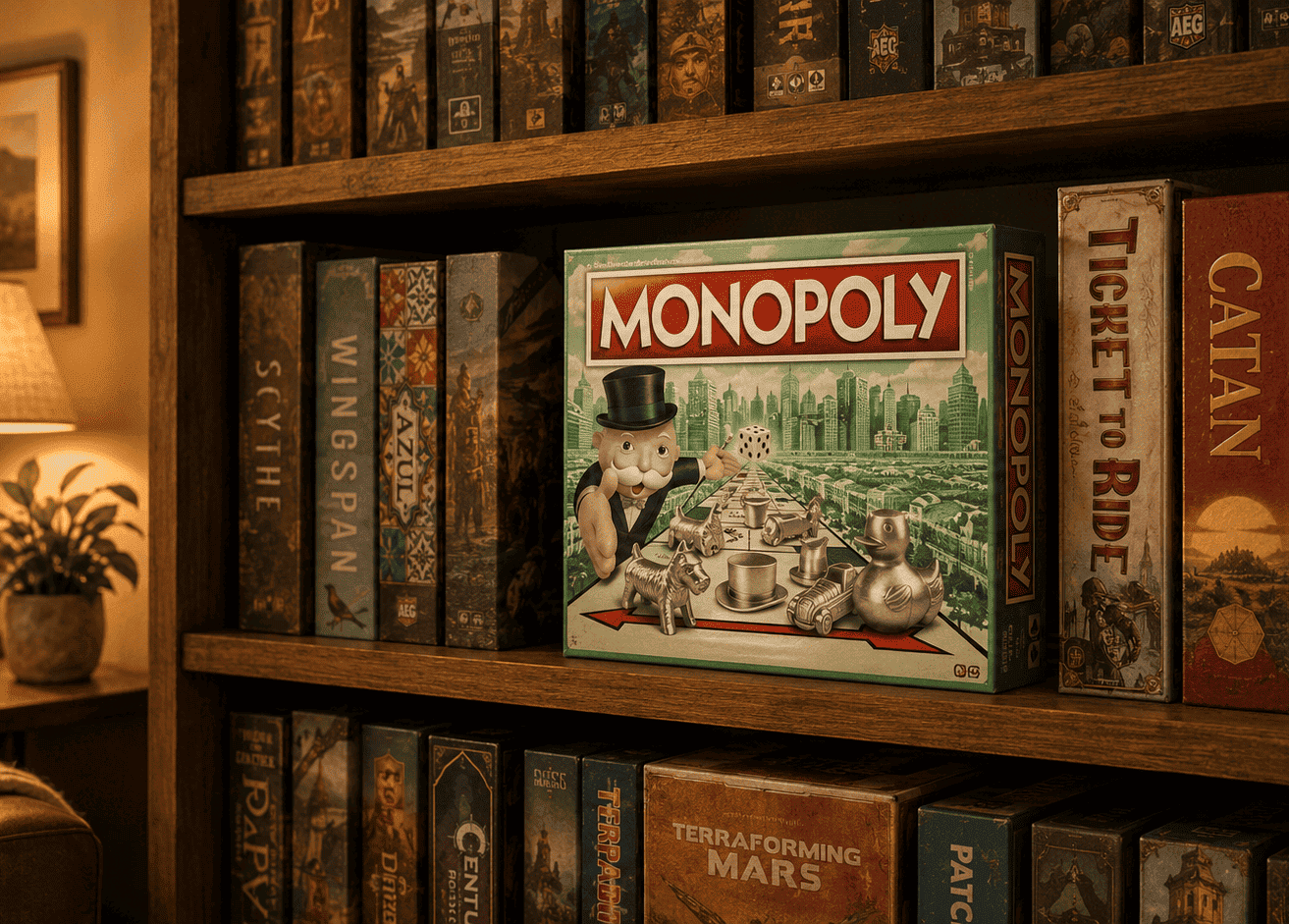
You do not need to consider yourself a board gamer to recognise Monopoly. The coloured properties, paper money, metal tokens, houses, hotels, and arguments over who owes what have become part of popular culture. For many families, it was not simply one game among many. It was the board game brought out during holidays, rainy weekends, and visits with relatives.
But familiarity alone does not fully explain why the game has endured. Players criticise Monopoly for many aspects of its design, yet people continue to buy it, give it as a gift, argue over its rules, and create memories around it. The scale of its reach is difficult to ignore: as the game celebrated its 90th anniversary in 2025, Hasbro reported that Monopoly had been played by more than one billion tabletop players across 114 countries, with more than 300 licensed versions of the game. (source: Behind the Brands. | Hasbro ) So why is Monopoly still so popular? How one imperfect game really introduce generations to the wider world of board games?
Monopoly’s success cannot be explained by design quality. Mass-market distribution, accessibility, familiarity, social interaction, and decades of visibility through new editions and licences all helped it become one of the most recognisable board games in the world. These strengths do not erase its design flaws, but they help explain why the game has remained relevant for generations.
From The Landlord’s Game to a Global Icon
The story of Monopoly began long before the familiar Parker Brothers edition appeared. In 1903, American inventor and political activist Elizabeth “Lizzie” Magie applied for a patent for The Landlord’s Game, which was commercially published a few years later, around 1906. Inspired by the economic ideas of Henry George, Magie designed it to demonstrate how land ownership and monopolies could concentrate wealth while leaving others increasingly disadvantaged.
Over the following decades, the game spread informally between families, universities, and local communities, with players adapting the board and rules as they passed it along. One version eventually reached Charles Darrow, who presented it to Parker Brothers. The company began selling Monopoly in 1935, turning an evolving community game with anti-monopoly origins into the property-trading classic recognised around the world today. As you could already notice, Monopoly had over 120 years to build its position on the market. Most of the games get only around a year before they lose customers' and then distributors' interest.
The irony is difficult to miss: a game created to warn people about monopolies went on to become one of the most dominant commercial board game brands in history.
Why Monopoly Became the Game Everyone Knew
Monopoly did not remain popular because every generation independently decided it was the best game available. Its advantage was that it was:
easy to find, easy to understand, quick to put on the table, and increasingly familiar from one generation to the next.
Combined with decades of visibility through licensed editions, these qualities turned familiarity into a self-reinforcing advantage.
New Look of Toys: Board Games
To understand Monopoly’s success, we also need to look at the environment in which it was launched. At the time it first appeared on the market, the dedicated board game publishing landscape we know today did not yet exist. Games were largely handled by toy manufacturers, whose approach and especially their scale had little in common with that of board game publishers we know today. Toys were less focused on serving a specific hobby and much more on reaching the mass market.
While a standard distribution deal for a board game today might involve around 1,000 copies, in the toy industry you could easily add at least one zero to that number. Instead of your favourite local hobby shop, imagine a supermarket or a large retail chain. Those were the circumstances in which Monopoly entered the market, making it easier to build scale than in today’s far more competitive board game market.
The Basic Idea and the Progress Are Easy to Understand
The complete rules of Monopoly are not necessarily short, and many families play with their own house rules. However, the central idea requires very little explanation: move around the board, buy properties, collect rent, build houses and hotels, and try to become richer than everyone else.
Just as importantly, progress is highly visible. Players count stacks of colourful money, hold property deeds, complete sets, place houses, and eventually replace them with hotels. Success is not hidden behind an abstract score track. It spreads across the table.
That makes both progress and failure easy to read. You do not need to calculate victory points to recognise that the player surrounded by cash and buildings is doing well, or that handing over a large rent payment hurts. The theme and components support the same fantasy of becoming a successful property owner, making the game state immediately understandable even to inexperienced players.
This is a good example of how components do more than represent the rules. They shape how players understand progress, experience ownership, and react emotionally to what happens during the game. We explore this role further in Components: The Hidden Heroes of Board Game Design.
Quick and Simple Set-up
One of the common barriers in heavier Eurogames or area-control games is the time and effort required just to get everything onto the table. With Monopoly, that obstacle is almost nonexistent. And for a game aiming to become a mass-market title, that matters.
If you want a game to come off the shelf often, the set-up needs to be easy. If you want it to appear naturally during a family evening or a casual gathering with friends, the same rule applies: players should be able to start quickly, without sorting dozens of components or preparing a complicated board state.
Monopoly does exactly that. The board unfolds, the pieces are placed, the money is distributed, and the game can begin. In some editions, even the bank could effectively be taken out and set up in a single move. That simplicity lowers the barrier between “Should we play something?” and actually starting the game.
Familiarity Passed Between Generations
Monopoly benefited from knowledge being passed down rather than relearned from the beginning. Parents could introduce it to their children because they already understood the basic structure, while grandparents could often join without studying a new rulebook. Each generation helped keep the next one familiar with the board, terminology, and rituals of play.
That also made it feel like a safe choice. Newer board games may offer smoother rules or more meaningful decisions, but it must first overcome the uncertainty of being new. Monopoly arrives with fewer barriers because people already believe they know what kind of experience to expect.
A Monopoly for Every Fandom
Licensed editions have helped the game remain visible to new audiences. Versions connected to Marvel, Disney, Star Wars, Pokémon, Harry Potter, Super Mario, and many other franchises place its familiar structure inside worlds that children and adults already recognise.
For parents, this can make suggesting a board game easier: a child who may not care about traditional property names might still want to play with characters and locations from a favourite franchise. For fans, themed editions can also work as gifts or collectibles, giving people a reason to buy Monopoly even when they already own another version.
The rules remain broadly familiar, but the changing themes allow the brand to reintroduce itself to each new generation. Monopoly stays recognisable without always looking exactly the same.
The Social Experience Matters More Than Perfect Design
Monopoly may look like a game about moving around the board and collecting rent, but many of its most memorable moments happen between players. Trades, completed colour sets, painful rent payments, and sudden reversals create tension, laughter, and stories that last beyond the game itself.
Trading gives players the most direct control over what happens. The dice decide where they land, but completing a monopoly often depends on convincing someone to exchange a property. Players must judge the value of a deal, hide how badly they need it, and persuade the other side that the exchange is worthwhile.
That turns a simple property-collection game into one of negotiation, bluffing, temporary cooperation, and shifting power. Trading may not look like the central mechanism at first, but in practice it is one of the main reasons Monopoly becomes so social.
Why Board Game Players Often Dislike Monopoly
Monopoly’s popularity does not mean its design has aged equally well. Players familiar with newer board games often criticise it because much of the experience can feel outside their control, gameplay happens to be endless, while those who fall behind may spend a long time waiting for an outcome that already seems inevitable - a clear indications of snowball and lack of catch-up mechanism.
Luck Can Overshadow Decisions
Players can negotiate trades and decide how to manage their money, but many important moments still depend on dice rolls. Where you land determines which properties you can buy, whether you complete a valuable colour set, and whether you suddenly owe another player a devastating amount of rent.
Randomness is not automatically a design flaw, but in Monopoly it can strongly influence who receives the best opportunities. A player may make reasonable decisions and still struggle because they repeatedly land on occupied properties while others avoid them.
Falling Behind Can Be Difficult to Reverse
Once one player completes a strong property set and begins adding houses, their advantage can grow quickly. The rent they collect funds further development, while the players paying it lose the money they need to compete. This is what we call a snowball.
Success generates more success, while recovering from an early disadvantage becomes increasingly difficult. The resulting drama may be memorable, but it can also make later turns feel less meaningful for those already far behind. Such circumstances usually result in someone leaving the table and starting to do something else.
Player Elimination Breaks the Common Experience.
Unlike many family games, Monopoly can remove players before the session ends. Someone who goes bankrupt may have no choice but to watch while the remaining players continue, sometimes for a considerable amount of time.
Even before elimination, a struggling player may remain technically involved without having many realistic options. Modern designs often try to avoid this by keeping everyone active until the end or reducing the time between recognising the likely winner and actually finishing the game.
These weaknesses help explain why many hobby gamers prefer newer designs, but they do not erase the social appeal that made Monopoly memorable in the first place.
Was Monopoly Really a Gateway to Board Games?
Calling Monopoly a gateway game depends on what we mean by “gateway.” For generations, it introduced people to the experience of gathering around a table, following shared rules, managing money, negotiating with others, and watching a game develop over an entire evening. In that sense, it was a cultural gateway: it made board gaming familiar even to people who never thought of it as a hobby.
However, Monopoly did not always lead players to try other games such as Catan or Ticket to Ride, or to explore the much wider range of board games available today. For some, its negotiation and competition created curiosity about other games. For others, it became almost the entire definition of what board games were - long, luck-driven, and likely to leave someone frustrated before the end.
Monopoly was therefore not necessarily a gateway into the hobby. Its role was broader: it normalised board gaming for generations of people who might never have considered themselves board gamers at all.
What Board Game Designers Can Still Learn from Monopoly
Monopoly is probably more useful as a lesson than as a model to copy. Its success and its weaknesses point to a few principles worth remembering:
- Reduce barriers before the game even begins. Easy set-up, familiar actions, and a clear objective make it much easier for a game to reach the table.
- Make progress easy to read. Players should understand who is advancing and why—but progress should also move the game towards its conclusion.
- Give players reasons to interact. Some of Monopoly’s most memorable moments come from negotiating with people, not manipulating the board.
- Build an identity people can recognise. Components, theme, presentation, and terminology can make a game memorable beyond its mechanisms.
- Do not confuse drama with meaningful decisions. Big swings can create stories, but players still need enough agency to feel that their choices matter.
- Keep everyone involved until the end. Snowballing and elimination may create tension, but they can also leave players waiting for a game that has effectively already been decided.
The lesson from Monopoly is not to copy its mechanisms, but to notice how accessibility, interaction, identity, and pacing shape whether a game is actually played and remembered.
Conclusion: The Beginning, Not the Destination
Monopoly may not represent everything we got used to while playing games from top 100 BGG ranking, but it's influence is difficult to deny. For generations, it gave families a familiar reason to gather around one table, manage money, negotiate deals, celebrate lucky moments, and argue over rules.
Its greatest achievement may not be that players still consider it the best-designed game. It is that Monopoly became part of popular culture and helped make board gaming feel familiar rather than unusual. For some players, it remained the only board game they knew. For others, it was the beginning of a journey towards more varied and carefully designed experiences.
Monopoly was not always the destination, but for many people, it was the first stop.
Want to Go Deeper?
Are you impressed by Monopoly’s lasting success and wondering whether your own idea could become just as memorable? Or perhaps you see where the game shows its age and believe you can create something with more meaningful decisions, less downtime, and a better experience for everyone at the table.
Do not stop at the idea. Board Game Design Fundamentals: A Step-By-Step Guide will help you turn your concept into a playable prototype, test it effectively, recognise common design problems, and improve the game one decision at a time.
Created together with the experienced designers and developers of the Pamper Playtesting Group, the course provides a structured path through the board game design process: from the first inspiration to a game ready for serious playtesting and presentation.