When people think about board game design, they usually think about mechanics. Worker placement, deck-building, dice rolling, engine building. These are often seen as the heart of every game. Components come later, almost as a packaging decision. In practice, the relationship often works the other way around.
The physical form of your game influences how players interact with it, what information they notice first, and even which mechanics feel natural to use. Sometimes a simple change to a component can unlock ideas that would never appear if you stayed with your original design.
Experienced designers know that components are more than containers for mechanics. They're part of the design itself.
Stop Treating Components as a Default
Many design decisions happen almost automatically:
- Cards are vertical.
- Boards are rectangular.
- Tokens are round
Not because these are always the best choices, but because they're familiar. We rarely stop to ask whether another approach would better support the experience we're trying to create.
This is one of the easiest traps to fall into as a designer. Once you accept every standard as the obvious solution, you stop looking for alternatives. Yet many memorable games stand out precisely because someone questioned those defaults.
The goal isn't to be different for the sake of being different.
The goal is to choose components that naturally support your game's mechanics and theme.
When Turning a Card Sideways Solves a Design Problem
Card orientation is a simple example. Most board games use vertical cards because that's what players expect. It works well in many situations, but it isn't a rule. Sometimes a horizontal layout simply makes more sense.
A wider format gives illustrations more space, allows text to breathe, and creates room for a cleaner arrangement of icons. In some games, it also changes how players organize cards in front of them, making information easier to read throughout the game.
A good example is Finspan. the game focuses on fish: long, horizontal creatures that naturally fit a landscape layout. The wider cards don't just improve the artwork. They also make it easier to communicate information that's important during play, while allowing players to tuck cards beneath each other more comfortably on their personal boards.
None of these decisions change the core mechanics. Yet together, they make the game easier to play and more satisfying to interact with. That's the kind of improvement designers often overlook because they're focused entirely on rules.
Components Influence the Entire Design
It's easy to think of components as isolated objects. A card is a card. A board is a board. In reality, changing one component often affects everything around it.
Take the game board. Most games use rectangular boards because they're practical. They're easy to print, manufacture, package, and store. Those are perfectly valid reasons, but they're manufacturing decisions, not design decisions. As a designer, it's worth asking a different question:
Is this shape helping my game?
Sometimes the answer is yes. Sometimes changing the board's shape creates entirely new possibilities.
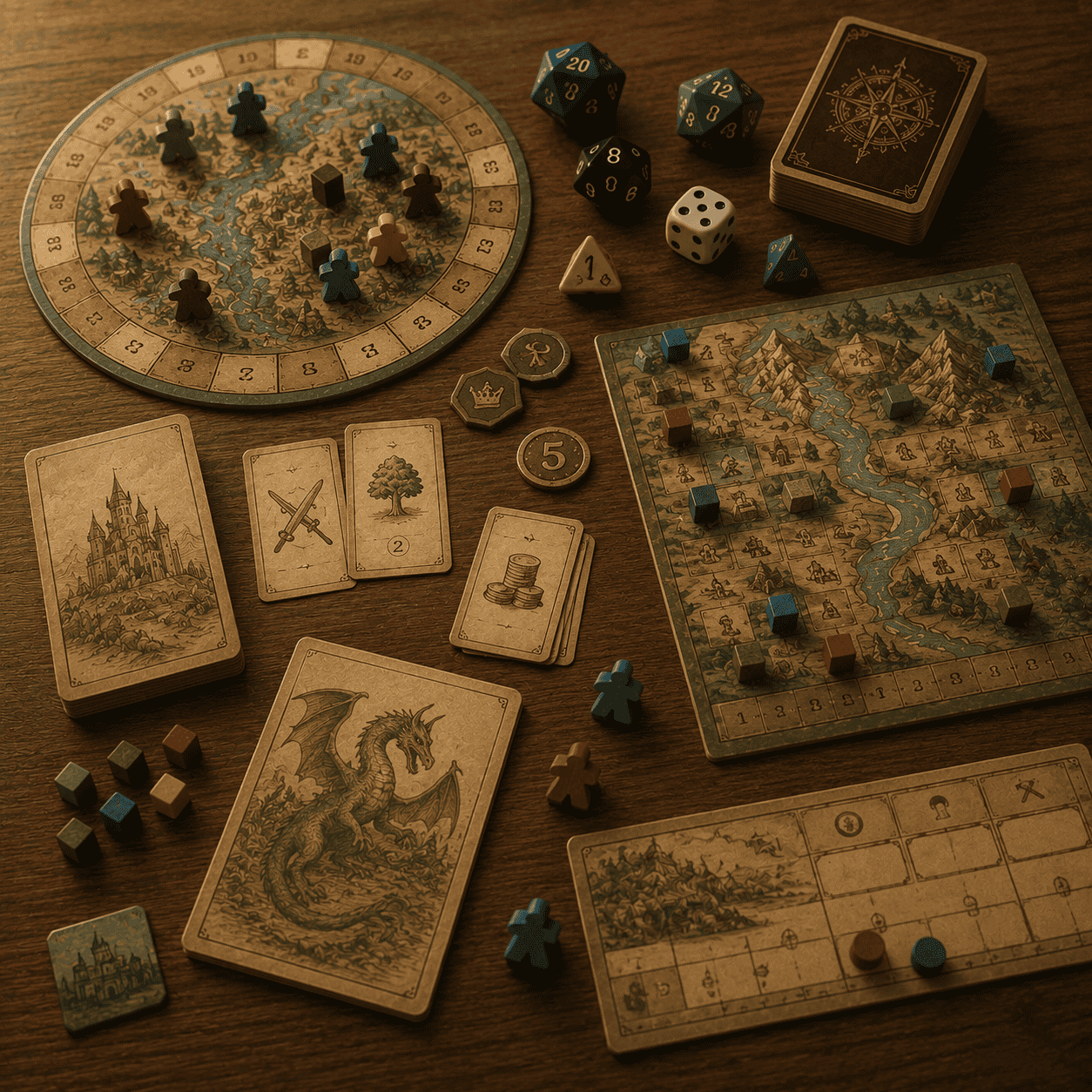
During one of my own projects, replacing a rectangular board with a circular one completely changed how players selected actions. Instead of moving across rows and columns, every action became part of a shared circle. The mechanic felt more intuitive, supported the game's theme, and encouraged players to think differently about turn order and planning.
The interesting part wasn't the circular board itself. It was the new mechanic that only became visible after changing the component.
Many good ideas don't appear while you're sketching systems in your notebook. They appear after you physically build something different and see how players interact with it.
(TableHop note: Before adding more cards, tokens, or boards, make sure your game's foundation is already working. Our article Core, Content, Balance: Why Most Board Game Designs Collapse (and How to Fix Yours) explains why expanding a prototype too early often slows down the entire design process.)
Let Your Components Inspire New Ideas
There's a common assumption that components exist to support mechanics. Sometimes it's the opposite. A different component can inspire an entirely different mechanic.
Changing the size of a card may encourage players to build a tableau instead of holding a hand. A larger board might create space for area control that didn't exist before. Even replacing cardboard tokens with cubes can change how players perceive resources and interact with the game.
These ideas rarely emerge from theory alone. They appear during experimentation. That's why it's worth treating components as design tools rather than production details. Every time you change the physical form of your prototype, you're also creating an opportunity to discover mechanics you hadn't considered before.
Not every experiment will improve your game. But every experiment teaches you something about it.
Final Thoughts
Board game design isn't only about creating interesting mechanics. It's also about creating the physical experience through which players interact with those mechanics.
(TableHop note: If You want to understand sources of fun in board game take a look at the article: The 8 Types of Fun in Board Games: How the MDA Framework Helps You Design for Emotion)
Cards, boards, tokens, and other components aren't neutral objects. They influence readability, ergonomics, decision-making, and the overall flow of the game. Small changes to their form can sometimes produce much bigger improvements than another round of balancing numbers.
The next time you find yourself stuck, don't immediately look for a new mechanic. Instead, look at the components already sitting on your table.
You might discover that the solution isn't changing the rules at all. It's changing the way players experience them.
Want to Go Deeper?
Components play a much bigger role in game design than many designers realize, and this article only introduces the idea. If you'd like us to explore topics like card layout, board design, component ergonomics, or production decisions in future articles, or even a dedicated course, let us know by email or on our social channels. We build TableHop around the questions our community wants answered.