Most beginner board game designers don’t fail because they lack ideas. They fail because they try to fix everything at once. A mechanic feels off, so they tweak it. A card seems weak, so they buff it. The game feels empty, so they add more content. Each change makes sense in isolation, but together they create something chaotic - a prototype that’s constantly moving, yet never improving. If that sounds familiar, you’re not alone. There’s a simple reason this happens:
you’re working on the right problems in the wrong order.
This article introduces a framework that helps you stay focused and actually move your design forward:
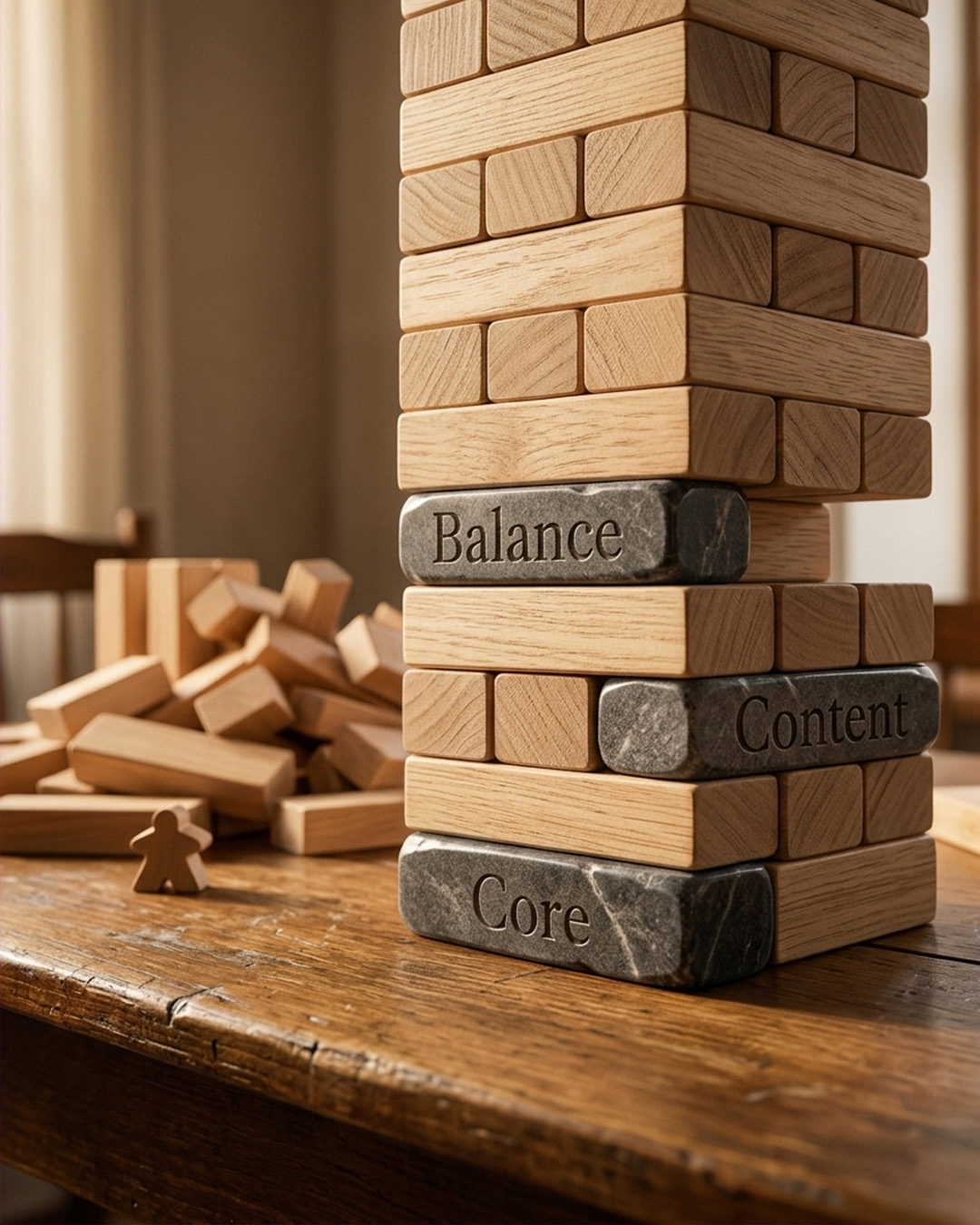
Core → Content → Balance
Get this order right, and your game has a chance. Ignore it, and you’ll spend months going in circles.
The Real Problem: Design Ouroboros
After a playtest, you come back with a mix of impressions, comments, and half-formed conclusions. Something didn’t feel right, but it’s rarely obvious what exactly went wrong. So you try to fix everything. You adjust the system, rewrite parts of the rules, add new ideas, remove old ones. Sometimes you even circle back to mechanics you already discarded, hoping they’ll work this time. This leads to what we can call the design ouroboros. In mythology, the ouroboros is a snake that eats its own tail creating a perfect loop with no beginning and no end. In design, it looks eerily similar:
- you add a mechanic;
- it doesn’t work, so you remove it;
- later, you bring it back in a different form;
- it still doesn’t solve the real problem.
And the cycle continues.
You’re not iterating. You’re circling.
The game keeps changing, but it doesn’t move forward. Because the issue was never that one element. You were just solving the wrong layer of the design. To break out of that cycle, you need a way to prioritize. Not all problems are equal, and more importantly, they shouldn’t be solved at the same time.
Core: What Your Game Actually Is
Your core is the foundation of the entire experience. It’s the thing you’re really designing, even if you don’t realize it yet. If someone asked you what your game is about, you wouldn’t list components or edge cases. You’d describe what players do and what it feels like.
In Magic: The Gathering, players cast spells and summon creatures to defeat each other. In Clank!, players build a deck while sneaking through a dungeon, trying to escape before the dragon catches them. That’s the core. Not the details, it's the experience. And here’s the uncomfortable truth:
If your core isn’t fun, nothing else will save your game.
You can add more content. You can polish the visuals. You can even perfectly balance every number. But if the central loop isn’t engaging, the game will always feel hollow.
If you want to think about “fun” more precisely, you can check our previus article with MDA framework:
The 8 Types of Fun in Board Games: How the MDA Framework Helps You Design for Emotion
At this stage, your goal isn’t perfection, it’s clarity. You’re trying to understand whether your idea produces meaningful engagement at all. A few useful questions can help you get there:
- Where did players genuinely enjoy themselves?
- Did the experience flow naturally, or did something interrupt it?
- Did players understand what they were trying to achieve?
Answering those questions is one thing. Turning the answers into a consistently engaging system is another and that’s where most designs struggle.
Content: What Gives The Game It's Shape
Once the core works, you can start building around it. Content is everything that fills the game and gives it texture: cards, factions, abilities, events, and all the small variations that create interesting decisions.
It’s also where expectations come into play. Players interpret what they see. If something looks fast, they expect speed. If it looks powerful, they expect impact. Good content aligns with those expectations instead of fighting them. A simple example is Star Realms. The core is straightforward: build a deck and attack your opponent. What makes the game engaging over time is the content. It's build with distinct factions, recognizable patterns, and different strategic directions. Without that layer, the core still functions, but it doesn’t carry the experience very far. This is where many designers quietly lose control of their project:
- they create too much too early,
- they become attached to untested ideas,
- they slow down iteration without realizing it.
More content doesn’t make your game better. Better content does.
A more effective approach is to start small. One version of a system. One example of a mechanic. Something you can test quickly and discard if needed. Because content design isn’t just about adding things. It’s about removing them. Knowing what to include is important. Knowing what to cut is often what makes the difference between a bloated prototype and a focused game.
Balance: Make It Fair (When It Actually Matters)
Balance is where many designers instinctively begin. It feels concrete. You can tweak numbers, compare values, and try to make everything “fair.” It creates a sense of progress. But early in the process, that progress is mostly an illusion.
You can’t balance a game that doesn’t work yet.
Balance only makes sense once the game itself makes sense. If your core isn’t stable or your content isn’t doing its job, adjusting numbers won’t fix the underlying issues. When you do reach this stage, the goal isn’t perfect symmetry. It’s meaningful choice. Players shouldn’t look at two options and immediately know which one is better. Instead, they should see different strengths, trade-offs, and situations where each option might shine. This becomes even more important in advanced cases like asymmetric design, where different players or factions operate under different rules. In those systems, balance isn’t about equality. It’s about giving each path a fair chance to succeed. If you want to explore that deeper, especially in the context of asymmetric balance, take a look here:
Rethinking Board Game Balance: Lessons Learned from Gutenberg
Understanding the concept is relatively straightforward. Applying it to a real game, with real players and real decisions, is where things become significantly more complex.
Why Order Matters
If you try to balance too early, you end up refining systems that may not survive the next iteration. If you build too much content before validating your core, you slow yourself down and introduce unnecessary complexity. But when you respect the order, something shifts. Each layer supports the next, and your decisions become more intentional.
Core creates the experience.
Content expands it.
Balance refines it.
A More Focused Way to Think About Iteration
After a playtest, it’s tempting to “improve the game” as a whole. But that mindset is exactly what leads back into the ouroboros. A more useful approach is to recognize the type of problem you’re dealing with:
- If the experience feels unclear or unengaging, you’re looking at a core issue.
- If the game lacks variety or identity, that’s content.
- If choices feel uneven or unfair, that’s balance.
This framework won’t tell you exactly how to fix each problem. But it helps you identify where the problem actually is, which is often the hardest part. And once you know that, your iterations become more focused, even if they’re still messy.
Final Thoughts
Designing a board game is a long process, and it’s easy to lose direction along the way. There are always more ideas, more feedback, more things you could fix. This framework doesn’t remove that complexity. But it gives you something most designers are missing:
A clear sense of what matters right now.
Start with the core. Build with content. Refine with balance.
In that order.
Want to Go Deeper?
This framework helps you understand what to work on. In our course, we go further into how to actually do it - step by step, with real examples, design decisions, and practical iteration methods:
Board Game Design Fundamentals: A Step-By-Step Guide
If you’ve ever felt stuck in your design process, that’s exactly what it’s built for.
Want to explore something next? Let us know by email or on our social channels. We’re into learning, and your feedback guides our next steps at TableHop.