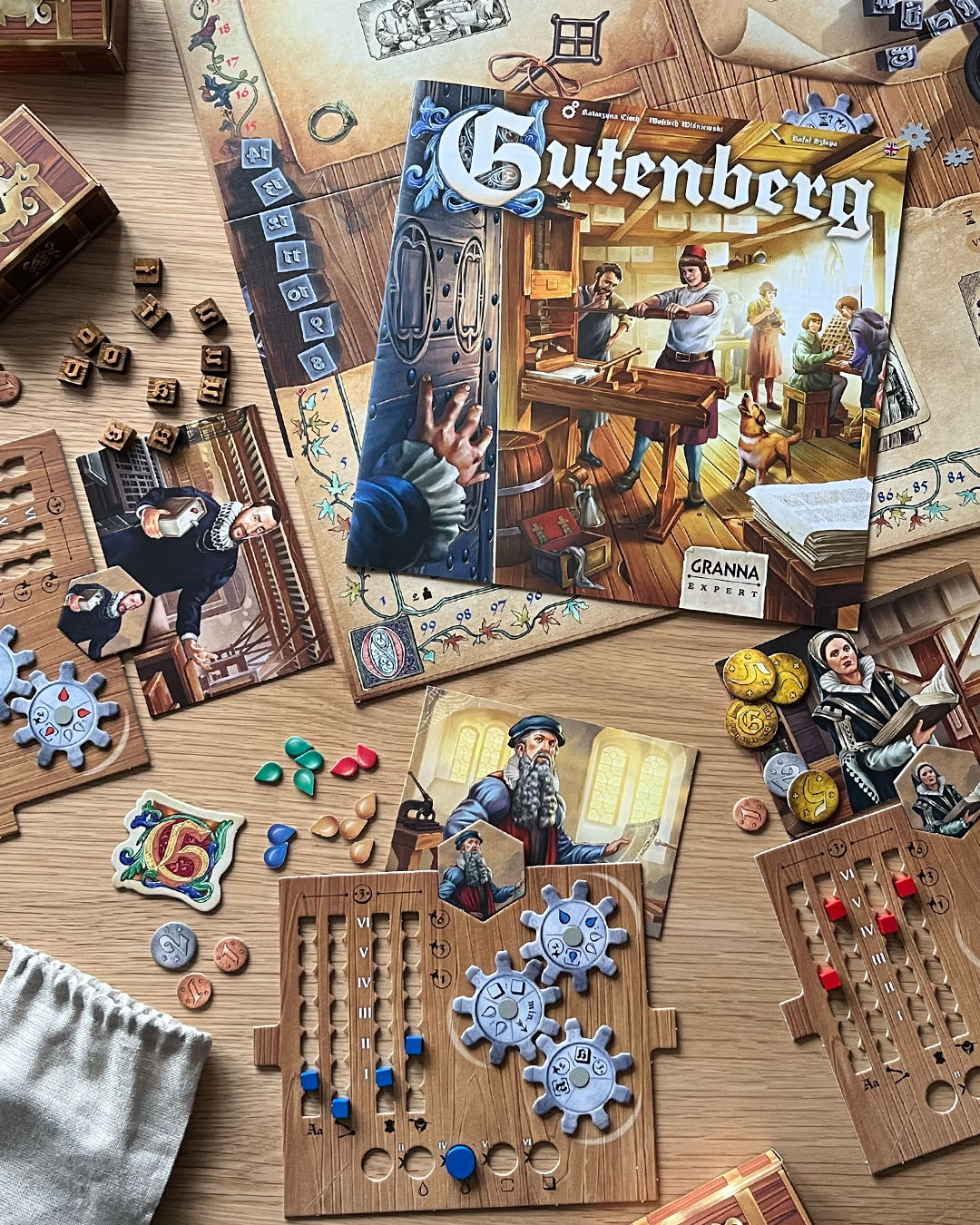
Balance is one of the most debated topics in board game design and often one of the most misunderstood. While analyzing player feedback for Gutenberg, one theme kept surfacing: certain characters felt “too strong” or “too weak.”
But what made this feedback fascinating wasn’t the criticism itself; it was the contradictions. In one review, Character X was “clearly broken,” while in another, X was “practically useless.” Other characters would get the same treatment, but in reverse.
(TableHop note: Contradictory player feedback does not necessarily mean the feedback is useless. It often means the underlying problem is more complex than the comment itself. We explore this in Playtest Feedback Is Lying to You: Here’s Why Designers Fall for It.)
That inconsistency reveals something essential: players don’t evaluate balance mathematically. They evaluate it experientially. And that’s exactly why the concept of “perfect balance” deserves a closer look.
Strong Characters Aren’t a Problem. They’re the Point
The feedback around Gutenberg reaffirmed a design principle we hold firmly:
Asymmetry is where the magic happens.
Games like Marco Polo and Hearthstone Battlegrounds have shown how transformative it can be when characters force players to approach the same system from radically different angles. A new role shouldn’t just tweak the numbers. It should change how you think, plan, and experiment.
Perfectly identical power levels might look “fair” on paper, but they drain excitement. If every character offers the same advantages, players lose any sense of strategic identity.
Balance without personality isn’t balance, it’s stagnation.
What Players Really Mean When They Say “Balance”
“Balance” is a convenient word players reach for, but the real expectation underneath it is quite different.
What players want is:
- confidence that their decisions matter
- a feeling that the game treats them fairly
- a sense that victory is attainable through different approaches
- proof that the designer didn’t “lock in” the outcome before the game began
The word balance becomes shorthand for agency. Understanding that distinction changes everything about how designers should approach asymmetric roles.
Perfect Balance Is Surprisingly Boring
One of the most counterintuitive truths about design is that:
perfect balance removes excitement.
When final scores consistently cluster together, players often walk away oddly unsatisfied. If every path leads to nearly the same result, then the only “correct” play is to avoid mistakes, not to explore or innovate.
And if a game feels solved, even unintentionally, players sense that the designer has removed their freedom.
A game can be too wild, of course. But a game can just as easily be too tidy, leaving players feeling like passengers rather than creators.
Mathematical Balance Isn’t the Balance That Matters
Designers often test characters with spreadsheets, simulations, probabilities, and long-term averages.
Players don’t.
Players remember:
- the explosive combo that stole the spotlight,
- the moment another character broke ahead,
- the feeling of helplessness when someone’s ability is triggered at the right time.
A single dramatic play can define a character’s entire reputation, even if the stats say otherwise. From the player’s perspective, fairness is not a calculation. It’s a story.
Why Clear Character Purpose Matters More Than Raw Numbers
Different roles naturally create different experiences. Without clear communication of those purposes, players may read intentional asymmetry as imbalance. And to be fair, mixing characters designed for completely different goals, some easing newcomers into the game, others breaking rules or creating high-impact moments, can amplify that perception. When one character exists to help you start smoothly and another to flip the game on its head, the contrast naturally feels off.
We saw this firsthand in feedback on Gutenberg: some players loved the wild asymmetry, while others felt the gap in character purpose made certain roles feel out of place. That contrast highlighted how important it is for players to understand why a role exists, not just what it does.
When the intent is legible, fairness becomes a matter of understanding, not symmetry, and that’s a lesson we’re carrying into future designs.
Designing Asymmetry That Feels Fair
Instead of chasing numerical equality, designers can focus on creating asymmetry that players trust.
Here are three principles that emerged strongly from our work on Gutenberg.
1. Give each character a coherent identity
Asymmetry becomes satisfying when players recognize the unique strengths, limitations, and playstyles built into each character.
Clear roles give players a lens through which to interpret differences as meaningful variety, not imbalance.
2. Keep powerful moments exciting, not overwhelming
One of the quickest ways to distort a character’s reputation is to let them create a massive one-turn swing. Even a single dramatic move can overshadow the whole arc of the game.
Keeping peaks in check leads to more consistent, less misleading perceptions.
3. Make strengths and weaknesses equally visible
A powerful ability feels fair when the tradeoff is obvious.
Players need to see not only what a character excels at, but also where it’s vulnerable.
If a character is strong yet transparent in its limitations, the table perceives it as balanced, even when its numbers are aggressive.
Final Thought: Balance Isn't Everything. Meaningful Asymmetry Is
The design philosophy that “everything should feel a little OP” holds a surprising amount of truth.
When asymmetry is intentional and thoughtfully crafted, it fuels:
- replayability
- memorable decisions
- strategic experimentation
- emotional highs
- genuine discovery
Balance is not a perfect equation.
It’s a feeling, a mixture of clarity, possibility, and trust that the game will reward clever play.
Players don’t need every option to be equal.
They need to believe they could have won if their plan had been better.
And that belief is the heart of perceived fairness.
Want more insights on asymmetric character design?
We don’t have a dedicated course on this topic yet, but if this is something you’d love to explore in-depth, let us know.
Your feedback helps shape what comes next at TableHop.