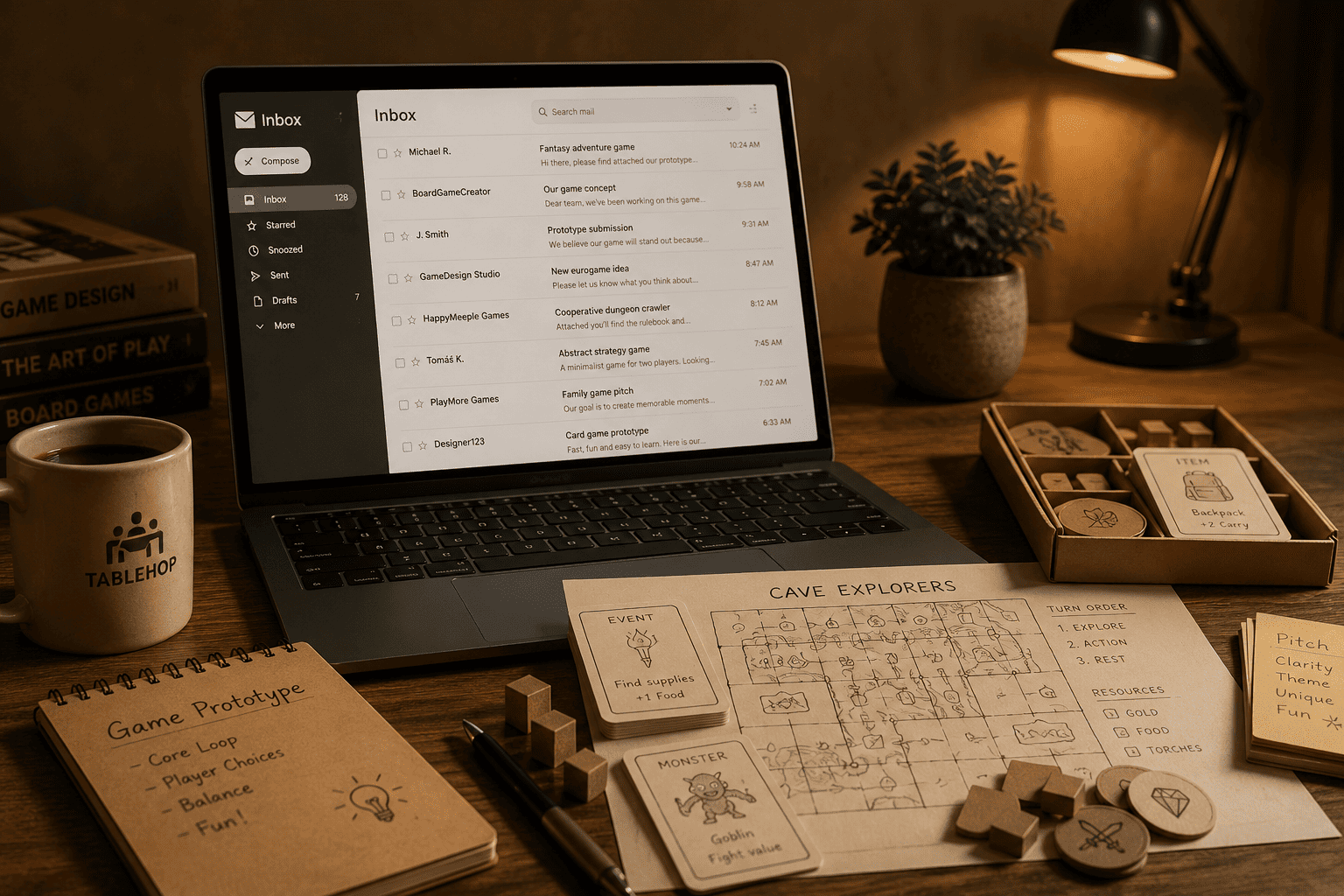
For many people who enjoy board games, there comes a moment when they feel the urge to design one themselves. Maybe you've played Root a hundred times and think you have an idea that would make it even better. Maybe you've been reading a comic with your child and the world is so inspiring that you want to turn it into a game you can play together. Or perhaps life simply throws enough challenges your way that designing a game becomes a creative outlet.
Whatever your motivation, sooner or later you may finish a prototype. After enough evenings spent asking family and friends to test it, someone will eventually say: "Maybe you should try to publish it."
And then what?
At that point, reality begins. You either decide to publish the game yourself or you approach a publisher. This article is about the second path: a world where excitement is quickly replaced by revisions, difficult decisions, and countless iterations.
A Prototype Being Accepted Is Only the Beginning
One of my responsibilities as a lead developer is evaluating prototypes submitted by designers. In practice, that means I'm the person who rejects most of them. To give you some perspective:
Out of every hundred submissions:
perhaps ten catch my attention.
Out of those ten, only one usually reaches internal testing with the development team.
Even then, there is no guarantee it will ever become a published game.
Let's assume your prototype is the one that makes it through. Many designers think that means the difficult part is over. In reality, that's the moment when the real work begins. One sentence I've heard countless times is:
"The game has already been tested. It's ready for publication."
If someone gave me a coin every time I heard that, I probably wouldn't become a millionaire, but I'd certainly have enough for a beer.
The truth is that it's extremely rare for a prototype to work exactly as its creator believes. Internal testing almost always reveals mechanics that need improving, systems that create unnecessary complexity, or ideas that simply don't fit the direction the publisher wants to take. The question is no longer "Is this game good?" but rather:
"Is this game worth investing months of additional development into?"
Every Publisher Has Its Own Publishing Model
Many first-time designers assume that once a publisher accepts a game, the next step is manufacturing. That's rarely how it works.
Every publisher has its own publishing model, target audience, production limits, and editorial philosophy. Authors usually design games from the heart, without thinking about those constraints and that's perfectly natural. Your dream is simply to see your game on a store shelf and say, "I made this."
The publisher sees something different. They ask whether the game fits their catalogue, whether it appeals to their audience, how expensive it will be to produce, and how much additional development it will require before it's ready for release.
That often means changing mechanics, simplifying systems, reducing components, or even rethinking major parts of the design. Those changes aren't made because the original game was bad. They're made because publishing a board game means turning a promising prototype into a commercially viable product.
Good Development Requires Good Collaboration
Every designer has a different personality. Some are open to discussion and experimentation. Others become attached to every mechanic they created. The same is true on the publisher's side. Every developer has their own habits, preferences, and way of working.
The best collaborations happen when both sides understand that they share the same goal.
Personally, I know I have my own opinions and biases. Like every developer, I naturally have ideas about how I think a game should evolve. But every day I also try to challenge those assumptions, because development isn't about proving that I'm right. It's about finding the best possible version of the game together.
The same applies to designers. If every suggestion feels like an attack on your vision, collaboration quickly becomes difficult. If you treat feedback as an opportunity rather than criticism, development becomes much more productive.
(TableHop Note: One of the biggest surprises for many first-time designers is discovering how much a published game can change during development. If you're interested in why experienced designers aren't afraid to rebuild working prototypes in search of better solutions, take a look at Don't Be Afraid to Change: Why Your First Solution Is Rarely the Best.)
Balance Isn't Everything
One mistake I often see, especially from less experienced designers, is chasing the perfect balance. Authors proudly explain that every number has been carefully calculated and every card has been tested dozens of times. Sometimes that's true. But there's a much more important question:
Does the publisher actually want to publish this version of the game?As Łukasz Włodarczyk often says,
"Balance is overrated."
That doesn't mean balance isn't important. It means it isn't the first thing that matters. Publishers aren't looking for mathematical perfection. They're looking for games that create memorable experiences. If a game is boring, even the most perfectly balanced mechanics won't save it. Quite often, changing a mechanic entirely creates a much bigger improvement than endlessly adjusting numbers.
(TableHop's Note: This is exactly the idea we explore further in Question Your Solutions, Not Just Your Numbers, where we discuss why challenging the mechanic itself often leads to stronger designs than simply tweaking values.)
More Components Don't Automatically Mean More Gameplay
Another common habit among first-time designers is trying to include everything they find interesting:
- Another resource.
- Another deck of cards.
- More tokens.
- More mechanics.
- More systems.
Some of this comes from enthusiasm, while some comes from a lack of experience. It's surprisingly difficult to recognise what can be removed without hurting the game. In my opinion, that's one of the hardest skills in game design:
Adding ideas is easy.
Cutting them is painful.
Every removed mechanic feels like wasted work, yet simplifying a design is often what allows its strongest ideas to shine. Publishers spend a lot of time identifying exactly where those cuts should happen.
Final Thoughts
So what kind of prototype should you bring to a publisher? Honestly? Everything.
I genuinely enjoy playing prototypes. They represent something you rarely find in finished products: pure enthusiasm for an idea. They're still untouched by manufacturing budgets, marketing plans, and commercial compromises. Most prototypes are, in a way, too strange to live, but too unique to die.
Whether they eventually end up on a store shelf or in a forgotten box depends on many factors, but one of the biggest is the designer's willingness to keep improving them after they're accepted. Accepting feedback, questioning your own ideas, and embracing development aren't signs that your prototype wasn't good enough.
They're simply part of the journey.
TableHop's Note
Getting a publisher interested in your prototype is an incredible milestone, but it's only the beginning of the publishing process. Once your game enters professional development, collaboration, iteration, and difficult design decisions become part of everyday work.
If you're still preparing to contact publishers, you may also enjoy How to Pitch a Board Game to Publishers (Without Wasting Your Shot), where we explore how to present your prototype professionally before this next stage begins.