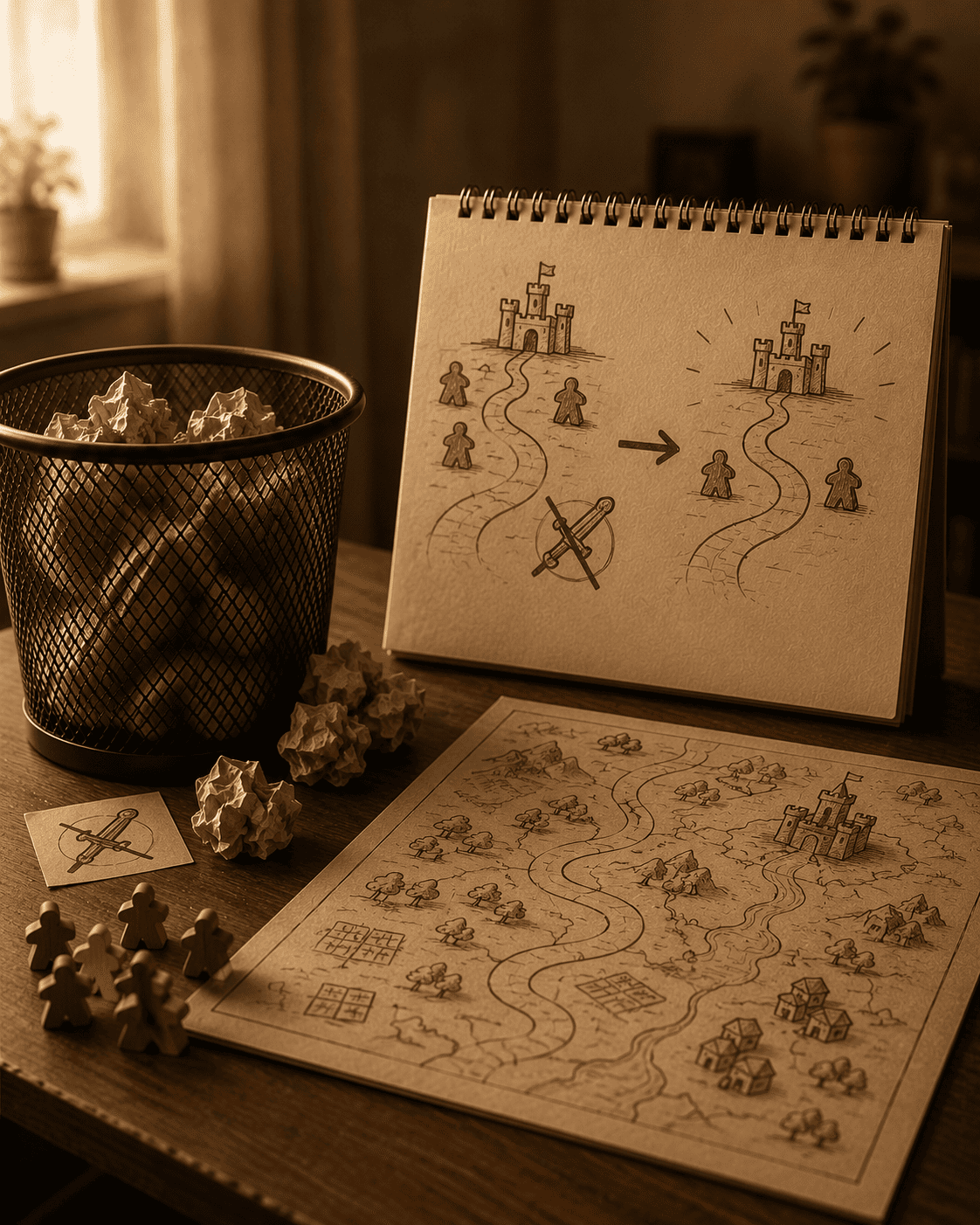
Over years of designing and testing board games, I've noticed a clear pattern: designers avoid changing their prototypes. When the time comes to revisit a working, but still mediocre, design, most hesitate and limit themselves to small cosmetic tweaks. A number gets adjusted, a rule is rewritten, or a card receives a slight buff, but the game itself rarely changes in a meaningful way.
It's an understandable reaction. After all, reaching a playable prototype already feels like an achievement. You've invested hours creating cards, balancing mechanics, and testing different ideas. Once everything finally works together, even imperfectly, tearing it apart feels like risking weeks of progress.
Ironically, that's often the exact moment when the biggest improvements become possible.
The prototypes that eventually become memorable games are rarely the ones that were protected from change. They're the ones whose designers weren't afraid to question their own ideas.
Why Designers Resist Change
There are usually two reasons for this behavior. The first is practical. Every meaningful change creates more work. Altering a single card value can affect the game's economy, force you to redesign part of the deck, recalculate the scoring, and repeat several rounds of playtesting. Replace one mechanic, and you may suddenly discover that another no longer makes sense. What looked like a small adjustment quickly turns into rebuilding half the prototype.
Because of that, designers naturally look for the safest option. Instead of asking whether the system itself should change, they focus on polishing what already exists. In some cases, small adjustments are enough. More often, however, they only delay a bigger redesign that the prototype eventually demands.
The second reason is much more difficult to notice because it has little to do with the prototype itself - It's attachment.
The longer we work on a design, the more familiar it becomes. We stop seeing individual mechanics as choices and start treating them as essential parts of the game. The original theme, components, and systems begin to feel like the only possible way the game could exist.
Without realizing it, we stop designing. We start defending our previous decisions. That's a dangerous place for any designer to be.
If you keep using the same solutions everyone else uses, and never question them, you'll likely end up with the same kinds of games everyone else is making.
The question isn't whether your prototype will change. It will. The real question is whether you'll be willing to make the changes it actually needs.
A Prototype Is Meant to Change
One of the biggest misconceptions among first-time designers is thinking that a prototype should gradually evolve into the final product. In reality, a prototype has a much simpler purpose. It helps you learn.
Every version answers a question.
- Does this mechanic create interesting decisions?
- Does the game encourage the kind of interaction you imagined?
- Does the pacing support the experience you're trying to create?
Sometimes the answer is yes. Sometimes it's no. Both outcomes are valuable because they move the design forward.
A prototype isn't successful because it survives every playtest unchanged. It's successful because each round of testing teaches you something you didn't know before.
That's why experienced designers often make changes that seem surprisingly bold. They aren't attached to preserving the prototype. They're focused on discovering the best version of the game.
(TableHop note: Iteration is the foundation of every successful prototype. If you haven't read it yet, check out How the Board Game Design Process Really Works, where we explain why good game design isn't a straight path, but a continuous cycle of prototyping, testing, feedback, and improvement.)
Don't Protect Your Solutions
Every board game is built from hundreds of design decisions. You choose mechanics because they seem to solve a particular problem. You select components because they support the experience you want players to have. You settle on a theme because it gives those mechanics context and meaning. At the beginning of the design process, these decisions are necessary. As development continues, however, they should never become permanent.
One of the most valuable habits a designer can develop is questioning earlier decisions instead of defending them. A mechanic that worked in the first prototype may become unnecessary after several iterations. A theme that once felt perfect may start limiting the direction of the game. Even a system that functions well can be replaced if another solution creates a stronger player experience.
Good designers aren't attached to individual mechanics or components. They're attached to creating the best game possible. Everything else should remain open to change.
(TableHop note: Changing a prototype doesn't always mean changing the rules. Sometimes the biggest improvements come from rethinking the components, the mechanics, or even the game's theme. We'll explore each of those perspectives in the next articles.)
Final Thoughts
Board game designers are often compared to inventors, and for good reason. An inventor is someone who improves their prototype endlessly and isn't afraid to destroy a working solution just to discover whether an even better one is hiding behind it.
The same mindset applies to board game design. Every prototype is only a snapshot of your current understanding. The goal isn't to prove that your first idea was right. It's to keep improving until you find a better one.
The prototypes that eventually stand out are rarely the ones that changed the least. More often, they're the result of countless decisions, revisions, and moments when the designer was willing to question something that already worked.
Don't be afraid to change your prototype. The solution you're protecting today may be the very thing preventing your game from becoming something truly memorable.
Want to Go Deeper?
Knowing that your game needs to change is one thing. Knowing what to change, when to change it, and how to evaluate whether the new version is actually better is an entirely different skill.
That's exactly what we cover in Board Game Design Fundamentals: A Step-By-Step Guide, where we break down the complete iteration process with practical examples, structured playtesting methods, and real design case studies.
Want to explore something next? Let us know by email or on our social channels. We're into learning, and your feedback guides our next steps at TableHop.