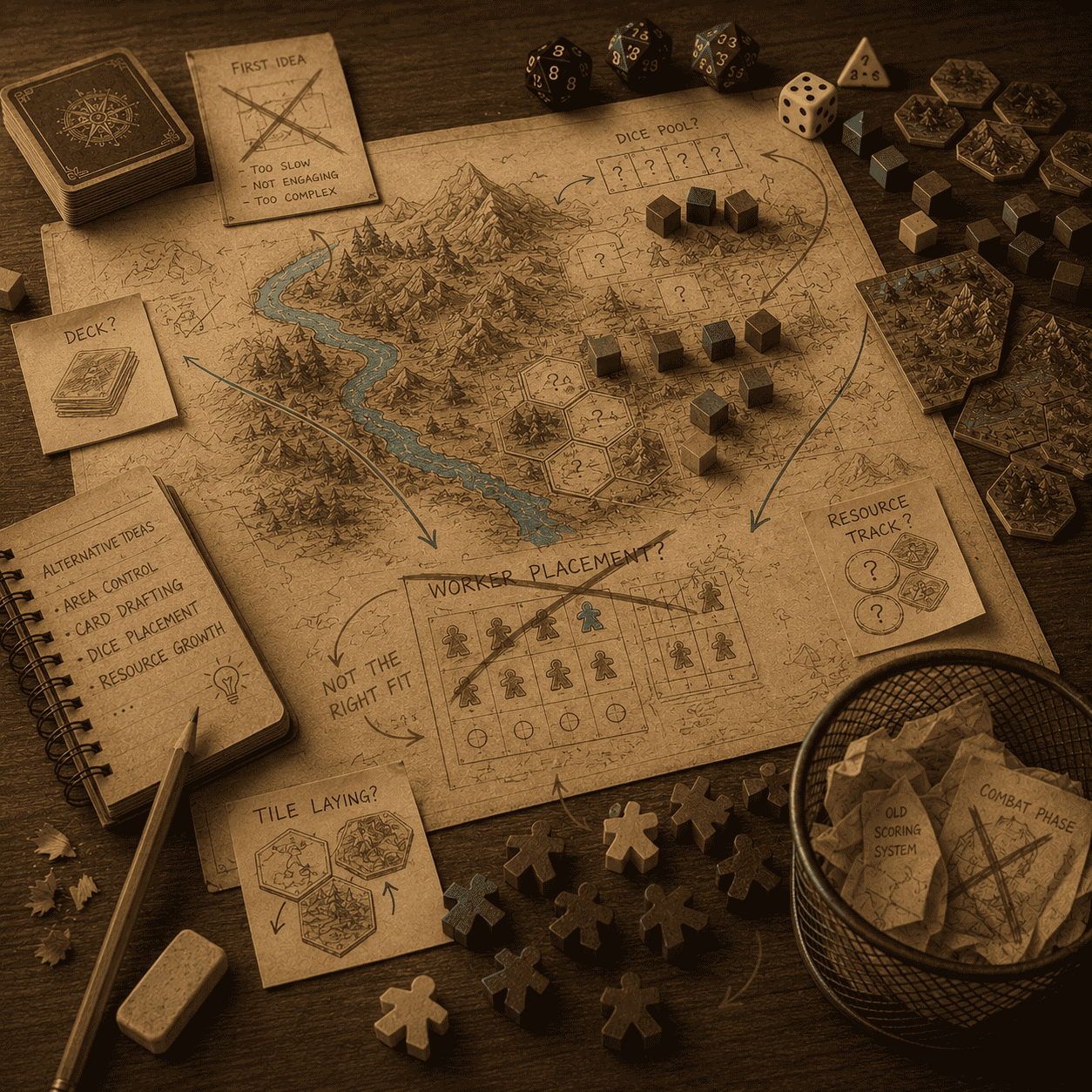
When something doesn't work in a prototype, our first instinct is usually to adjust the numbers. We increase the value of a card. We reduce the cost of an action. We tweak the scoring or modify a resource. These changes feel productive because they're small, measurable, and easy to test.
Sometimes they solve the problem. But sometimes the problem isn't the numbers at all. Sometimes it's the idea behind them.
One of the biggest steps in becoming a better board game designer is learning to question not only how a mechanic works, but whether it's the right mechanic in the first place.
Mechanics Are Tools, Not Goals
Every mechanic exists to achieve a purpose.
It creates tension, introduces uncertainty, rewards planning, or encourages interaction between players. Once you understand the purpose, you can begin asking a much more useful question:
Is this the best tool for the job?
Imagine your game needs a random value that appears repeatedly throughout the game. Many designers instinctively create a deck of cards. There's nothing wrong with that, but is it necessary? If the only goal is generating a random result, a die might achieve exactly the same outcome with fewer components, lower production costs, and a faster pace of play.
A deck becomes valuable when its structure matters. Players can count cards, manipulate probabilities, build strategies around the deck, or react to cards leaving play. If none of those decisions exist, the deck may simply be adding complexity without adding meaningful gameplay.
The important question isn't whether cards or dice are better. It's whether your chosen mechanic actually supports the experience you're trying to create.
Challenge Your Own Assumptions
One of the easiest ways to discover new ideas is to challenge the mechanics you've already chosen. Instead of asking how to improve your action selection system, ask a different question: What if it worked like a completely different game?
- How would your prototype change if actions were selected using a system similar to Carcassonne?
- What would player interaction look like if conflicts borrowed ideas from King of Tokyo?
Most of these experiments won't survive. That's perfectly fine. The value isn't in copying another game. It's in forcing yourself to look at your own design from a different perspective. Very often, you'll discover possibilities that weren't visible while you were trying to improve your original solution.
(TableHop note: If this sounds familiar, take a look at Don’t Be Afraid to Change: Why Your First Solution Is Rarely the Best - a deeper look at why attachment to early ideas can hold a design back.)
Sometimes Less Creates More
Designers naturally enjoy adding things.
- A new mechanic.
- Another deck.
- One more resource.
- An additional phase.
Adding ideas feels creative. Removing them feels like losing progress. Yet some of the strongest improvements happen when a mechanic disappears rather than when another one is introduced.
A prototype with fewer systems is often easier to understand, easier to balance, and more enjoyable to play. Every mechanic should justify its place in the design. If removing one makes the game clearer without making it less interesting, it probably wasn't as essential as it first seemed.
The same principle applies when combining mechanics or changing their importance. Sometimes a secondary system deserves to become the game's main focus. Sometimes two mechanics work better together than they do separately. There isn't a universal rule.
The important habit is staying willing to experiment.
Don't Be Afraid to Change the Theme
Mechanics aren't the only thing designers become attached to. Themes can be even harder to abandon. Many projects begin with a world, a story, or a setting that feels exciting enough to build an entire game around. After months of development, changing that theme can feel almost impossible. But themes don't just decorate mechanics. They influence them.
Every theme carries its own internal logic. It suggests actions, relationships, conflicts, and objectives that naturally support certain mechanics while making others feel forced. Sometimes a design problem that seems impossible to solve suddenly becomes obvious after changing the theme.
A good example is Viticulture. Most of its mechanics fit the theme remarkably well, helping players intuitively understand what they're doing throughout the game. Interestingly, one detail doesn't quite match reality: harvested grapes don't continue to ripen the way they do in the game. Yet most players either don't notice or simply accept it because the rest of the experience feels coherent.
That's an important lesson:
Players usually forgive small thematic inaccuracies if the overall experience feels believable.
Designers, on the other hand, often spend weeks trying to preserve a theme that may no longer be helping the game.
Sometimes changing the theme creates more opportunities than endlessly searching for another mechanical fix.
Final Thoughts
There's a well-known piece of writing advice that says:
"Kill your darlings"
The same principle applies to board game design. Not every mechanic deserves to survive. Not every theme needs to stay. Not every idea that worked in the first prototype belongs in the final game. The best designers aren't the ones who always have the right idea first. They're the ones who aren't afraid to replace a good idea with a better one.
Every major improvement begins with a simple question:
What if this isn't the best solution after all?
Want to Explore This Topic Further?
Choosing mechanics, refining themes, and deciding what to remove are some of the hardest parts of board game design. We've only introduced the way of thinking behind those decisions here.
If you'd like us to explore mechanic selection, theme integration, or advanced iteration techniques in future articles, or even a dedicated course, let us know by email or on our social channels. Your feedback helps shape what we create next at TableHop.