Designing a great board game is only half the challenge. Whether you plan to launch on Kickstarter or Gamefound, or you're preparing to pitch your prototype to a publisher, people need to discover your game before they can play it. Video has become one of the most effective ways to market a board game long before the final product reaches players. More importantly, it helps communicate what makes your game exciting, builds trust with potential players, and creates anticipation throughout development. Used well, it doesn't just sell a game: it builds trust, creates anticipation, and helps turn an invisible prototype into something people genuinely want to follow.
You've got a brilliant mechanic. Your Excel sheet is a mathematical work of art, everything balances perfectly, and your playtesters didn't instantly hate you after the first game. Congratulations, you've got a game.
The problem? At this stage, to most of the world, that game is invisible. It exists only in your head and on pieces of cardboard scrawled with sharpies.
If you plan to publish your game, whether you're going the crowdfunding route through Kickstarter or Gamefound, or pitching it to a publisher - you need to understand one thing:
Video is not a luxury. It's the lens through which players view your product.
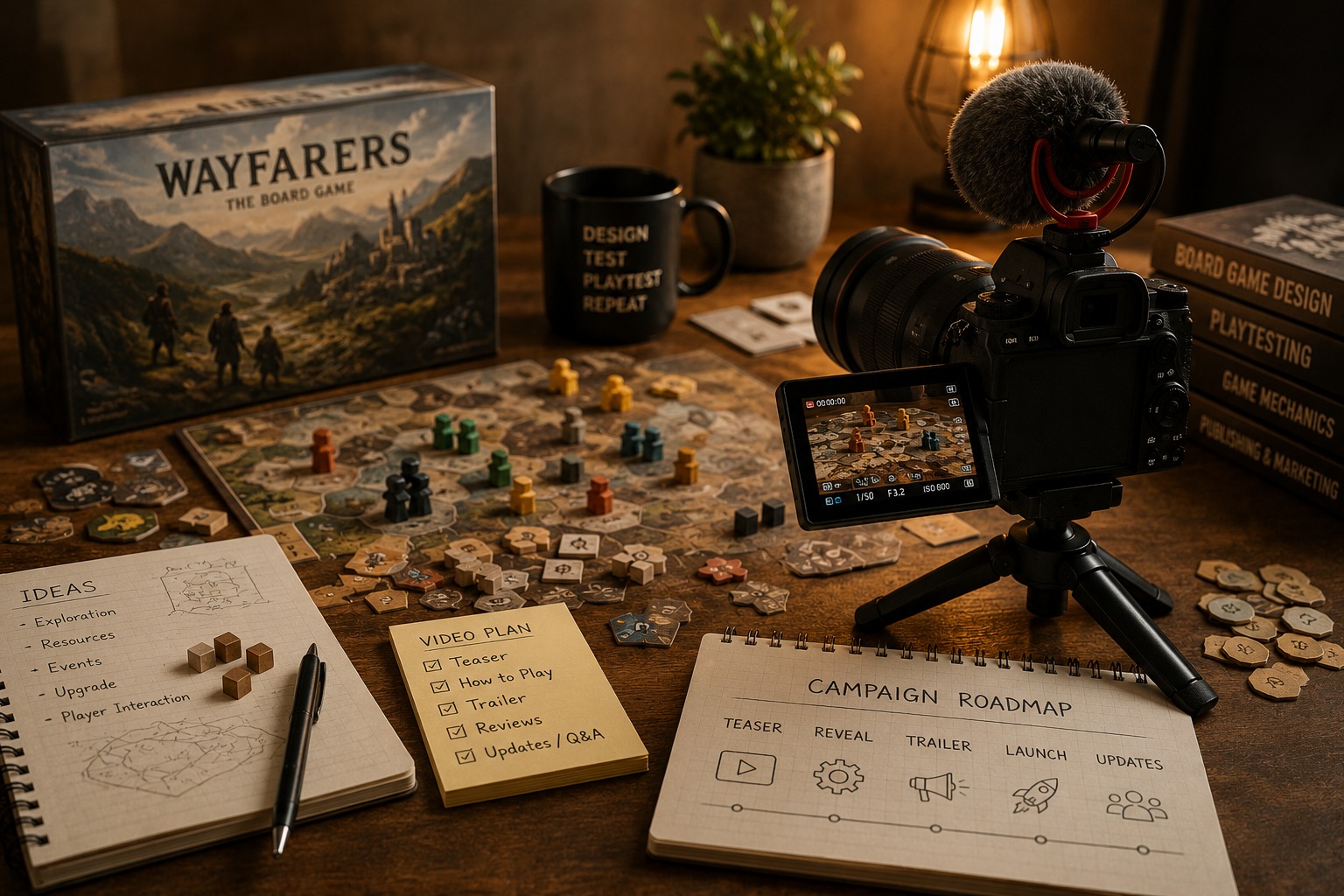
The biggest mistake designers make is thinking they only need video once: on launch day. In reality, video communication is a continuous process that works best when it's tailored to the different stages of your game's development. Here is your brutally practical roadmap - from the initial concept to the final printed box.
(TableHop Note: Before you start recording trailers or gameplay videos, make sure your game's foundation is solid. A compelling video can't compensate for unclear mechanics or an unfocused design. If you're still refining your prototype, you may want to read Core, Content, Balance: Why Most Board Game Designs Collapse (and How to Fix Yours))
1. Build Hype Early: Create a Board Game Teaser
Don't wait until the factory sends you the final production copy before you start thinking about marketing. If you want people to care about your game when it launches, you need to start building that interest long before it reaches print.
At this stage, you probably have early sketches or concept art, either your own or provided by the publisher. Use them. Even if they aren't final, they establish the atmosphere of your game. Within the first few seconds, a viewer should immediately understand whether they're looking at a light-hearted party game, a cosy family experience, or a heavy, grimdark Euro. If artwork doesn't exist yet, spending a few dollars on high-quality stock illustrations that capture the mood of your world is often enough to communicate the right feeling.
In your teaser, lean heavily into your unique hook - the exact thing that makes your game stand out. You don't need to scream that it's the "world's first party-racing game with castle-building elements." Sometimes, a simple, memorable differentiator works much better:
- "The entire game fits right in your hoodie pocket.
- "An immersive campaign that delivers dozens of hours of gameplay."
- "Your friends will absolutely hate you after a single session."
Keep it short, atmospheric, and punchy. Hook the viewer, give them just enough to spark their curiosity, and leave them wanting more.
2. Show How Your Board Game Works: The Mechanics Reveal
People know the vibe by now, but board gamers are demanding hobbyists. They won't back a game just because it has a pretty cover. At some point, you need to show them how the game actually plays.
In this video, your sole focus is the core gameplay loop. Pick your key mechanics and demonstrate them with concrete examples. Show viewers things like:
- What does a player's turn actually look like?
- How does that unique combat or card-drafting system work?
- What makes your gameplay different from other games in the same genre?
The Golden Rule of Transparency is simple: show the game using whatever components you have on hand, even if it's cardboard tokens cut out by hand and handwritten cards. Just put a clear disclaimer on the screen: "Prototype components. Not final version."
Gamers get it, and they'll respect your honesty. They aren't expecting factory-quality components at this stage. They simply want to know whether the gameplay is something they'll enjoy.
(TableHop Note: A short mechanics video can also become a valuable part of your publisher pitch. If you're approaching publishers rather than crowdfunding, read How to Pitch a Board Game to Publishers (Without Wasting Your Shot) to learn how a concise video presentation can help communicate your game's core experience and increase your chances of being invited for a meeting.)
3. Create Your Main Board Game Trailer
This is the moment to bring out the big guns. The trailer is the flagship video for your game. It'll sit at the top of your crowdfunding campaign page, on YouTube, and all over your social media. There is no room for improvisation here - this is pure marketing.
Pack this video with as much juicy content as you possibly can. Show off the final (or near-final) aesthetic beauty of your game. Most importantly, evoke the exact same emotions players will experience around the table.
- If you're making a relaxing game about foraging for mushrooms in the woods, the video should be calm, almost hypnotic, with a soothing soundtrack.
- If you're making a fast-paced, bloody skirmish game, the editing should be rapid, the cuts punchy, and the music aggressive.
Translate your mechanics into pure emotion. If players can feel the experience through the screen, they'll want to feel it around their own table.
4. Let Other People Talk About Your Game
You can talk to the camera for hours about how your game is the eighth wonder of the world, but let's face it - you're the creator, so your opinion is inherently biased by parental love. Gamers know this. That's why one of the most powerful fuels for hype is having someone else sit in front of a camera and say: "We played this, and it is damn good."
At this stage, partnering with independent reviewers and content creators is a massive move.
Make sure the prototype you send them doesn't have to be final production quality, but it should look clean, be easy to read, and present well on camera. A polished prototype allows reviewers to focus on the game rather than its rough edges.
In many cases, the reviewer will naturally point out that "the components look incredibly promising and sharp, and since this is just a prototype, the final product can only get better." That kind of endorsement feels genuine because it comes from someone who isn't the creator.
Timing is everything here. Coordinate a synchronized release date with your reviewers (a media embargo) so their videos go live alongside your campaign launch. If coverage appears randomly over several weeks, you scatter the hype. But when a potential backer opens YouTube on launch day and sees several trusted creators talking about your game at the same time, it sends a crystal-clear signal: "This is a hit. This is what everyone is talking about right now."
5. Keep the Conversation Going
Going dead silent after dropping a trailer is a big mistake. The development and manufacturing process takes months, and throughout that time you need to prove the project is alive and kicking. Celebrate every meaningful step forward and keep your community involved in the journey.
Campaign Updates
Did the factory just send over a new component sample? Instead of writing a dry text update, pull out your phone and shoot a quick video. Show the new component and give it context. Say something like:
"Check this out - this is the plastic density we went with based on your feedback."
or
"Take a look at the thickness of these dual-layered player boards."
Small updates like these reassure backers that production is moving forward and the game is one step closer to reaching their shelves.
Show the Game in Action
Once you have a version of the game that looks reasonably close to the final product (again, it doesn't have to be perfect), record a full gameplay video. People want to see what an actual session feels like, not just how the rules work.
Sit down at the table, turn on the cameras, and simply play. Show the table talk, the laughter, the analysis paralysis, the unexpected moments, and the genuine emotions your game creates. That's the experience players are ultimately backing.
Answer Your Community's Questions
Backers want to know everything, and they'll always have questions. Record dedicated Q&A sessions to answer them. You don't need to rent a studio. A simple talking-head video recorded in your gaming room is more than enough.
Address player concerns directly, and if someone asks about a specific rule, pick up the components and physically demonstrate how it works. Video lets you explain things much faster and much more clearly, than a wall of text ever could.
Conclusion: Pick Up the Camera
In the board game industry, video isn't just a sales tool. It's a trust-building tool. By showing the entire journey, from a rough teaser and prototype mechanics to gameplay sessions, campaign updates, and factory samples, you stop being an anonymous creator on the internet. You become a partner, inviting players to follow the journey of bringing a game to life.
That kind of transparency doesn't just help you launch one successful game. It helps you build a community that will be excited to see what you design next.
TableHop Note: Want to Go Deeper?
Video marketing is becoming an increasingly important part of publishing and crowdfunding board games, and this article only scratches the surface. If you'd like us to explore topics like creating crowdfunding trailers, recording gameplay videos, working with reviewers, or planning a board game marketing campaign in future articles, or even a dedicated course, let us know by email or on our social channels. We build TableHop around the questions our community wants answered.