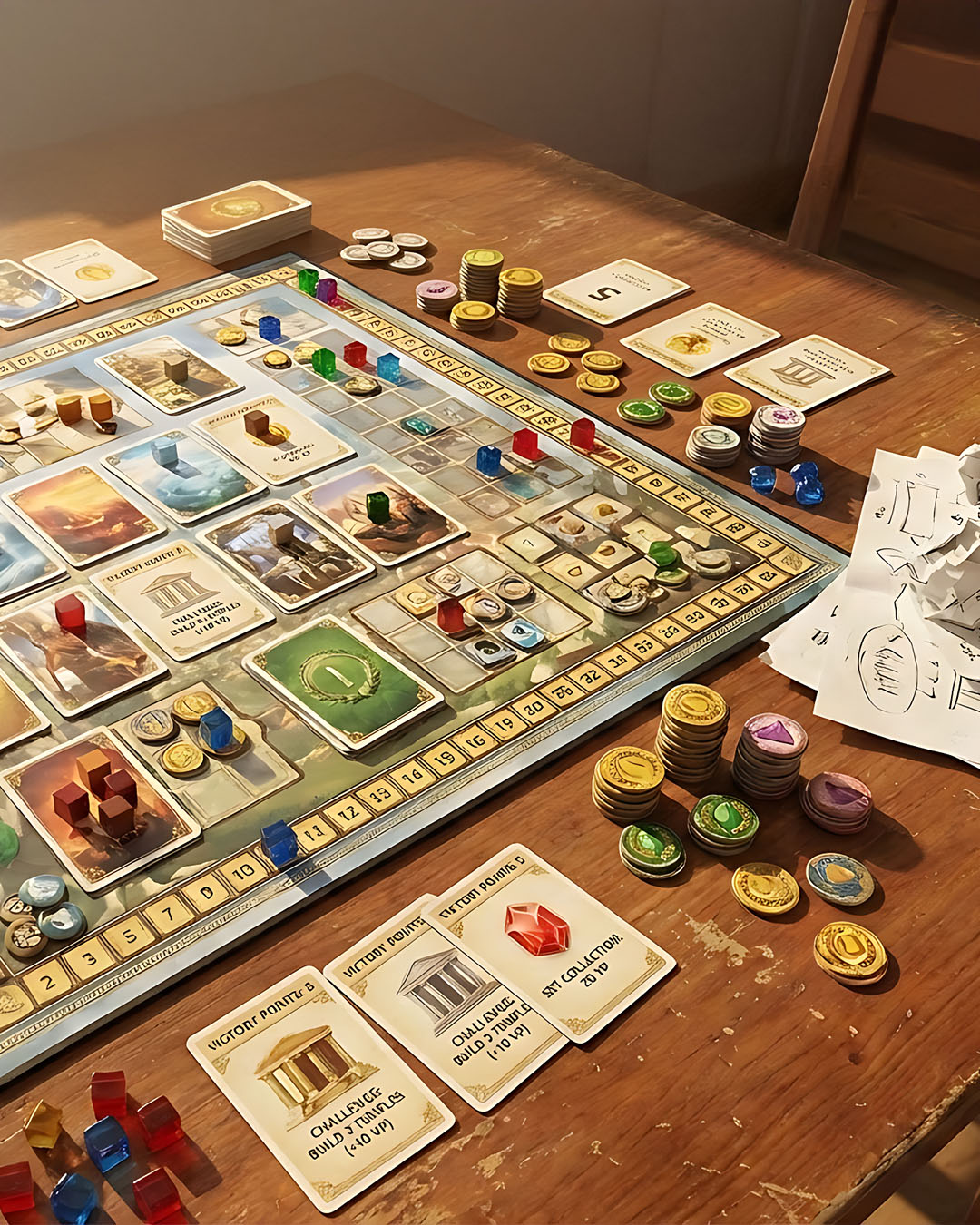
When designing a board game, how you define victory conditions shapes the entire player experience. Scoring systems, especially point-based ones, are everywhere, but that doesn’t mean they’re always the best solution. In fact, the way you structure your end-game scoring can decide whether players feel engaged and strategic or frustrated and confused.
Let’s break it down.
Execution vs. Outcome: What Are You Rewarding?
Keith Burgun often emphasizes how critical it is to separate execution (how well a player carries out a plan) from strategy quality (how good the plan itself is).
If a game mostly rewards execution like pulling off a perfect combo or getting the right draw, the experience can feel repetitive or stressful. Personally, I’ve sat at tables thinking, “maybe this time that big combo will finally work”… and it rarely leads to a satisfying game. Instead of enjoying the decisions, I’m just hoping the pieces fall into place.
When board game scoring systems reward the quality of the strategy, not just whether a combo fired correctly, players can reflect on what they did rather than what the dice decided. That creates clearer feedback and a stronger sense of agency.
Scoring Systems and Feedback Loops
Scoring isn’t just about victory points. It’s about what the game teaches the player after each session. A well-designed scoring system acts like a feedback loop - showing players which of their choices were effective and which ones need rethinking.
If the scoring system focuses purely on execution, it’s often unclear what went wrong after a loss. Did the plan fail, or was it just bad luck? But if it focuses on strategy quality, the feedback becomes more actionable: “This plan wasn’t optimal. Try something new next time.”
Good feedback keeps players motivated because they feel they’re learning with every play. That sense of progress, even in defeat, is what turns a single match into the desire for a rematch.
Great scoring systems don’t just tell you who won; they tell you why.
SMART Goals vs "Get the Most Points"
Many board games fall into the trap of defining their objective as “Get the most points.” It’s measurable, but vague. It often forces players to interpret the real goal, which can lead to confusion or detachment.
One way to look at this problem and to design clearer, more motivating objectives is through the SMART framework, originally developed in management and project planning to define effective goals. The idea translates surprisingly well into game design, helping us think about what makes a goal meaningful for players. Think of the SMART framework as a checklist for goals. They should be Specific, Measurable, Attractive, Realistic, and Time-bound. Let’s break that down a little further:
- Specific: “Get points” doesn’t say much. Clear objectives like “control 5 districts” or “reach the finish line first” give players focus.
- Measurable: Points are measurable, but only with a reference point (other players or an automa).
- Attractive: Speaking personally, I often care less about abstract points and more about building something fun: a smooth engine, a city full of factories, a palace that feels earned. If I win just by collecting points, it can feel oddly empty.
- Realistic & Time-bound: Easy to control, but not necessarily motivating.
You can win a point-based game and feel nothing, or lose badly and still have fun. That’s a sign your game’s core joy lies somewhere deeper than the scoreboard.
Why Point Systems Still Work (Sometimes)
Point systems remain popular for good reasons:
- Easy to measure and compare.
- Add tension throughout the game.
- Offer satisfying micro-rewards when the score track jumps forward.
But if the only clear objective is “collect the most points,” the strategy can feel shallow. Great games give players a meaningful target, not just a number to chase.
Final Thoughts: Designing Better Scoring Conditions
The best victory conditions reward strategy, not just luck or flawless execution.
Whether it’s missions, area control, resource goals, or clever hybrids, clarity and purpose make players feel in control of the outcome.
For me, the most satisfying games are the ones where the scoring system shows me why my plan worked or didn’t, not just how many points I collected. When scoring reflects the quality of strategic decisions, it creates room for learning, iteration, and better play next time.
Point systems aren’t inherently bad, but they work best when they support a strategic core rather than define it. A strong scoring design gives players a clear sense of progress and teaches them something valuable about their decisions. That’s what makes them want to come back to the table.
(TableHop note: If you want to explore the idea of a game’s core in more detail, take a look at Core, Content, Balance: Why Most Board Game Designs Collapse (and How to Fix Yours).)
Want more insights on scoring systems?
Scoring is one of those mechanics that can make or break a game, and we’ve only scratched the surface here. We don’t have a dedicated course on board game scoring systems yet, but if this is something you’d love to dive deeper into, drop us a message.
Your feedback helps us shape what comes next at TableHop.